

SPF KNOWLEDGE HUB
Understanding Spray Foam Insulation
Spray foam insulation is one of the most effective ways to improve a building’s energy efficiency, comfort, and long-term performance, but only when it is properly understood and correctly installed.
Many insulation decisions are made based on incomplete information, outdated practices, or product claims without context. In reality, insulation performance depends on how heat moves, how air leaks, and how the building envelope is designed and executed.
This guide brings together the key principles, comparisons, and practical insights needed to make informed insulation decisions, whether you are planning a new project or improving an existing space.
INTRODUCTION TO SPRAY FOAM
Spray foam insulation is one of the most advanced insulation systems available today because it does more than just resist heat—it actively seals the building.
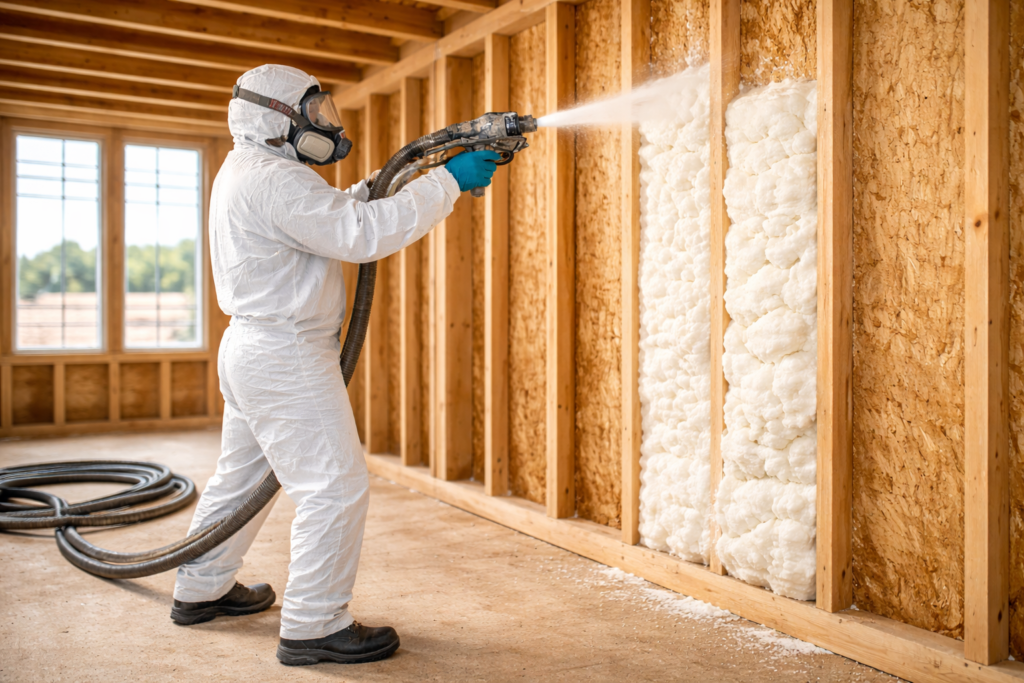
Unlike traditional materials, spray foam expands on application, filling gaps, cracks, and irregular spaces to create a continuous barrier against both heat transfer and air leakage. This dual function helps improve energy efficiency, indoor comfort, and long-term building performance.
When properly installed, it adheres directly to surfaces and maintains its shape over time, delivering consistent insulation without settling or shifting.
Read Full Details →
Spray polyurethane foam (SPF) insulation is designed to address two major sources of energy loss in buildings: heat transfer and air leakage.
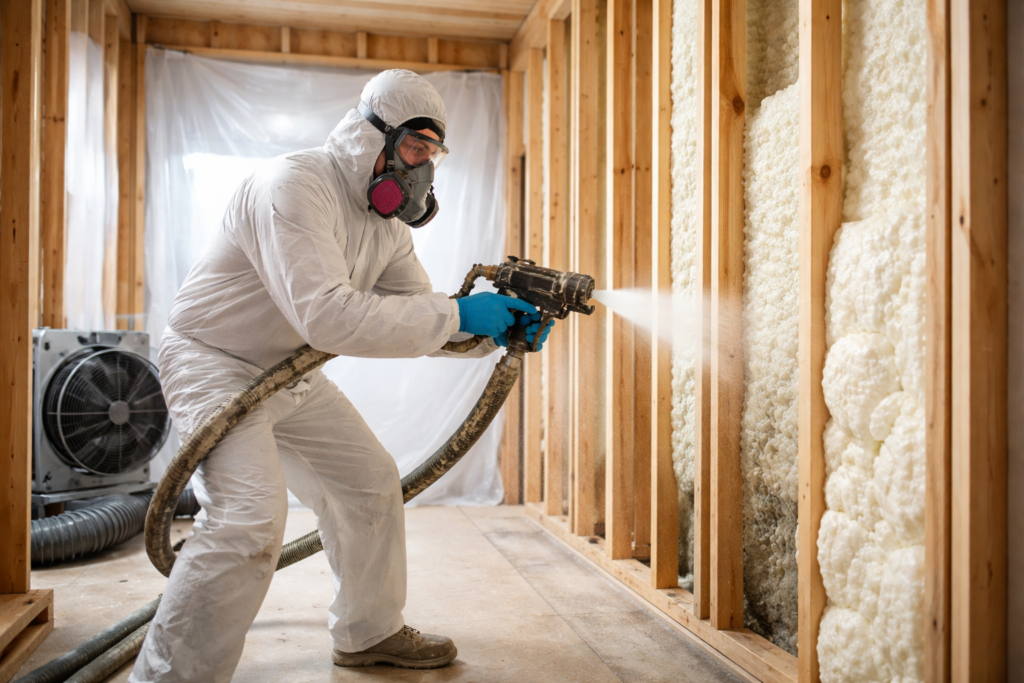
Unlike fiberglass or cellulose insulation, which primarily resist heat flow, spray foam expands upon application to fill cavities, cracks, and irregular spaces. This expansion allows it to form a continuous insulation layer that also acts as an air barrier.
By reducing uncontrolled air movement, spray foam helps:
• prevent drafts
• maintain consistent indoor temperatures
• reduce heating and cooling loads
• limit moisture movement within walls and ceilings
Because it adheres directly to surfaces such as wood, concrete, and metal, spray foam does not settle or shift over time like some traditional insulation materials.
When properly installed, spray foam insulation can last for decades and contribute to improved building performance, comfort, and energy efficiency.
WHAT SPRAY FOAM DOES
Spray foam insulation works by combining insulation and air sealing into a single system, addressing two of the biggest causes of energy loss in buildings.
As it expands, it fills gaps and hard-to-reach spaces within walls, ceilings, and structural joints—reducing air movement, stabilizing indoor temperatures, and limiting moisture transfer. This helps improve real-world performance, not just theoretical insulation values.
By controlling both heat flow and air leakage, spray foam creates a more efficient and consistent indoor environment.
Explore How It Works →
Spray foam insulation works by combining two critical functions into one system: insulation and air sealing.
When applied, the foam expands rapidly—often up to 30–60 times its liquid volume—allowing it to fill even the smallest gaps and irregular spaces inside walls, ceilings, and structural joints.
This expansion creates a continuous barrier that:
• prevents uncontrolled air leakage
• reduces heat transfer through conduction and convection
• limits moisture movement carried by air
• stabilizes indoor temperatures across seasons
Unlike traditional insulation materials that can leave gaps or settle over time, spray foam adheres directly to surfaces such as wood, concrete, and metal—ensuring consistent performance.
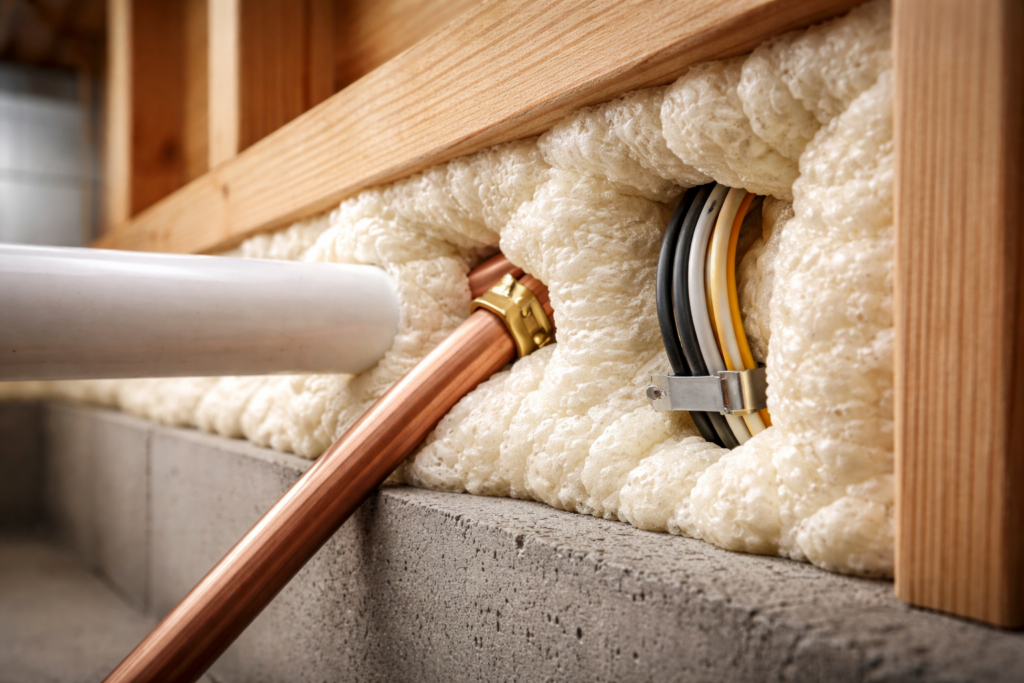
Air leakage is one of the largest contributors to energy loss in buildings. Even small openings around wiring, plumbing, or framing can allow significant heat loss. Spray foam addresses these weak points by sealing them at the source.
By controlling both air and heat movement, spray foam improves:
• indoor comfort
• HVAC efficiency
• long-term energy costs
• durability of building materials
This is why spray foam is often used in areas where traditional insulation struggles—such as rim joists, attics, and complex framing structures.
OPEN CELL vs CLOSED CELL
Spray foam insulation is available in two primary types—open-cell and closed-cell—each designed for different performance needs and applications.
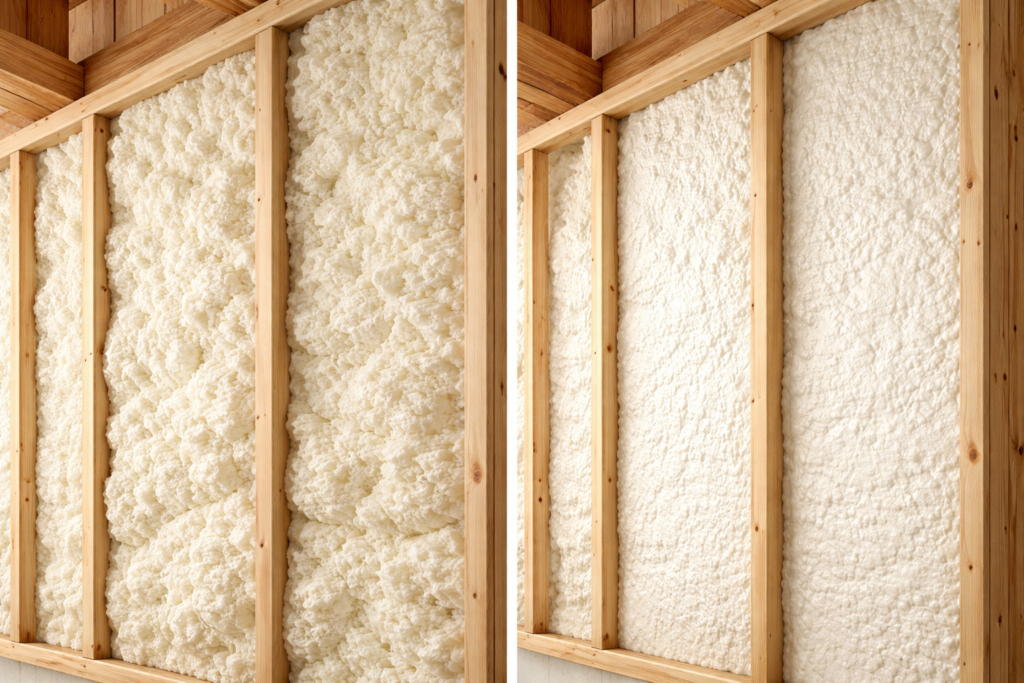
Open-cell foam is softer and more flexible, making it effective for sound absorption and filling larger cavities, while closed-cell foam is denser and more rigid, offering higher insulation value and better resistance to moisture.
Choosing the right type depends on factors such as location, available space, exposure to moisture, and overall performance goals within the building.
Compare in Detail →
Spray foam insulation is available in two primary types: open-cell foam and closed-cell foam. While both provide insulation and air sealing, their properties and applications differ significantly.
🔹 Open-Cell Spray Foam
Open-cell foam is a low-density material that expands significantly during application. Its structure contains tiny open pockets, making it softer and more flexible once cured.
Key characteristics:
• R-value typically around R-3.5 to R-4 per inch
• Expands aggressively to fill cavities
• Excellent for sound absorption
• Allows some vapor permeability (can dry through)
Best used for:
• interior walls
• sound control between rooms
• large cavities where expansion helps coverage
Because of its softer structure, open-cell foam is ideal for applications where flexibility and sound dampening are priorities.
🔹 Closed-Cell Spray Foam
Closed-cell foam is a high-density material with tightly packed cells, making it rigid and more structurally stable.
Key characteristics:
• R-value around R-6 to R-7 per inch
• High compressive strength
• Strong adhesion to surfaces
• Resistant to moisture and water absorption
Best used for:
• basements and foundations
• exterior-facing walls
• crawlspaces
• areas requiring high insulation in limited space
Closed-cell foam is often preferred in environments where moisture resistance and higher thermal performance are required.
🔹 Key Decision Factors
Choosing between open-cell and closed-cell depends on:
• location of application (interior vs exterior)
• exposure to moisture
• insulation thickness constraints
• performance expectations
In many projects, both types may be used in different areas of the same building to optimize performance and cost.
SPRAY FOAM vs TRADITIONAL INSULATION
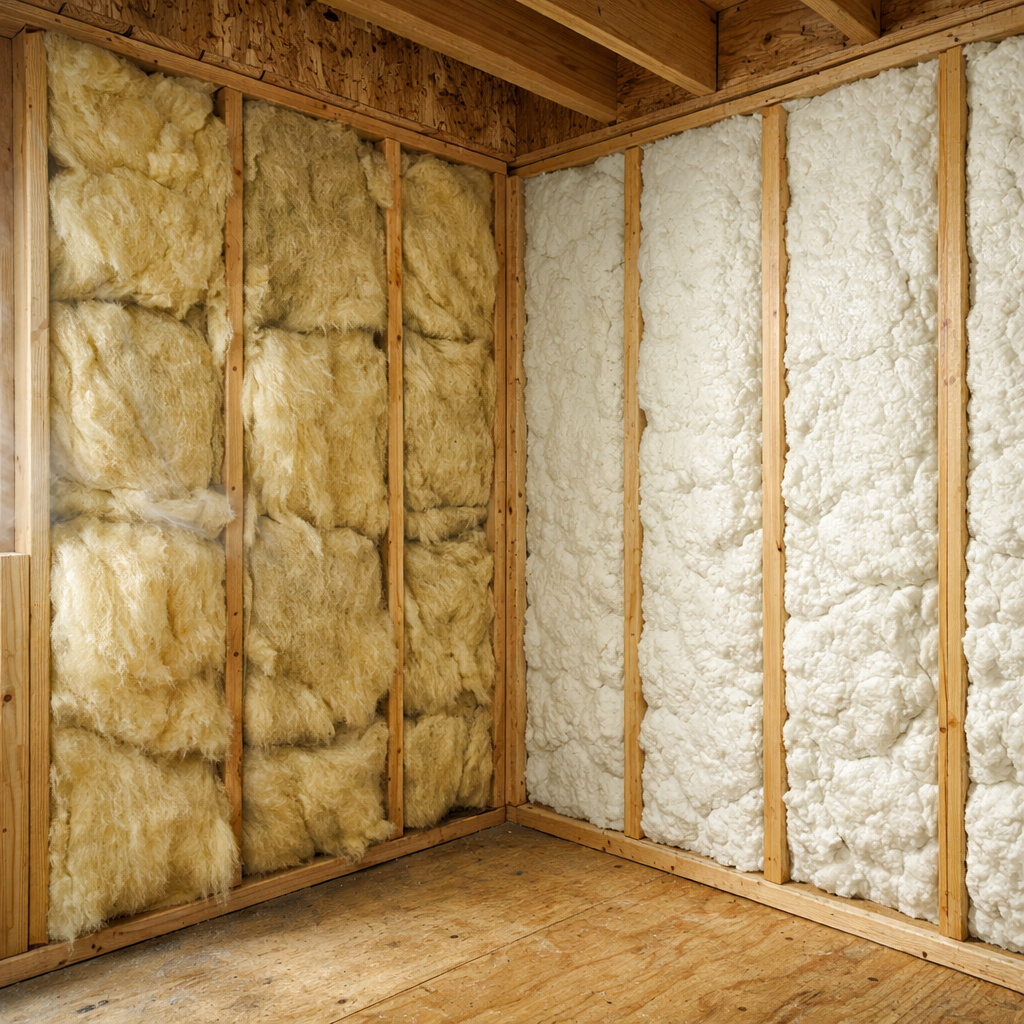
Traditional insulation materials like fiberglass are designed to slow heat transfer, but they often allow air to move through gaps, reducing their effectiveness in real-world conditions.
Spray foam takes a more complete approach by both insulating and sealing the building, helping prevent drafts, reduce energy loss, and maintain more consistent indoor temperatures.
This difference between laboratory performance and actual in-home performance is why insulation systems that address air movement tend to deliver better overall results.
See the Real Difference →
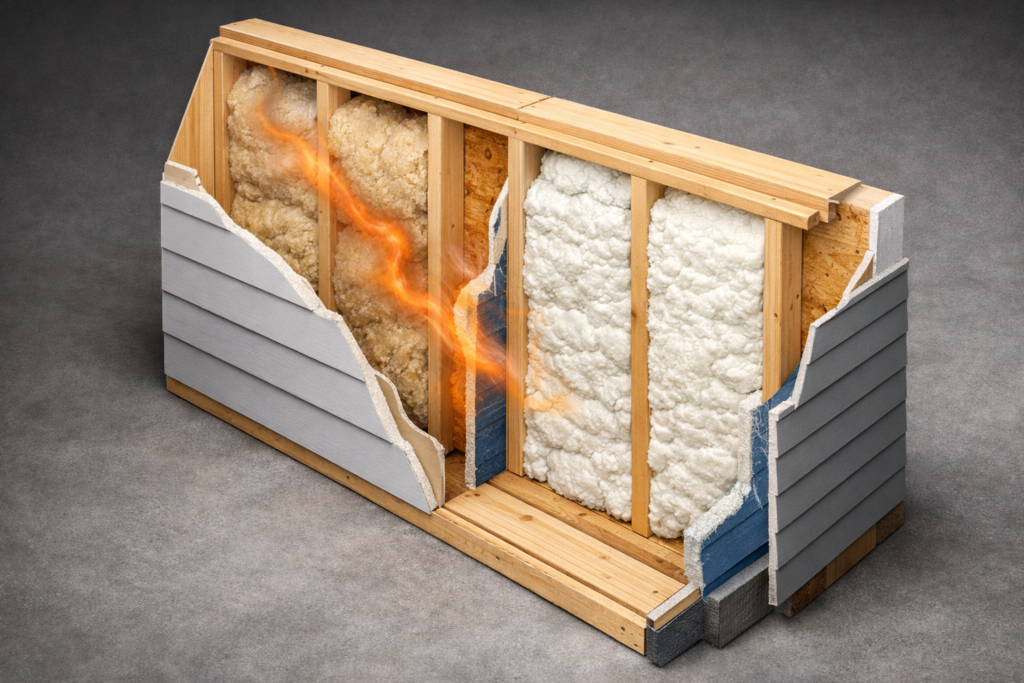
Traditional insulation materials such as fiberglass and cellulose are designed to slow down heat transfer. When installed perfectly, they can provide effective thermal resistance.
However, in real-world conditions, insulation performance is influenced by more than just material R-value.
🔹 The Limitation of Traditional Insulation
Fiberglass insulation does not stop air movement.
Small gaps, compression, or imperfect installation can allow air to pass through or around the insulation. This airflow can carry heat and moisture, reducing overall performance.
Common issues include:
• gaps around wiring and plumbing
• air leakage through joints and seams
• compression reducing insulation effectiveness
• settling over time
Because of this, actual performance often falls short of expected R-values.
🔹 How Spray Foam Differs
Spray foam expands on application, filling cracks and sealing gaps within the building envelope.
This creates:
• a continuous insulation layer
• an air barrier that reduces drafts
• improved thermal consistency across surfaces
By addressing both heat transfer and air leakage, spray foam performs more effectively in real-world conditions.
🔹 Why Air Sealing Matters
Air leakage can account for a significant portion of energy loss in buildings.
Even small openings can allow:
• warm air to escape in winter
• hot air to enter in summer
• moisture to move into wall assemblies
Spray foam reduces these pathways, helping maintain indoor temperature and reducing strain on heating and cooling systems.
🔹 Performance Over Time
Traditional insulation can:
• shift or settle
• lose effectiveness if disturbed
• depend heavily on installation precision
Spray foam, once cured:
• adheres to surfaces
• maintains its shape
• continues performing consistently over time
🔹 The Practical Difference
In controlled conditions, different insulation materials may appear similar on paper.
In real buildings, performance depends on:
• air movement
• installation quality
• continuity of insulation
Spray foam addresses these factors together, which is why it is often chosen for higher-performance building envelopes.
UNDERSTANDING R-VALUE
R-value measures how well a material resists heat flow, but it does not fully represent how insulation performs in real homes.
Actual performance depends on factors like air leakage, installation quality, and how the entire building assembly works together. Even high R-value insulation can underperform if air is allowed to move through or around it.
Understanding this difference helps explain why effective insulation is not just about material rating, but about controlling both heat transfer and air movement.
Understand What Really Matters →
R-value is a measure of how well an insulation material resists heat transfer. The higher the R-value, the greater the material’s ability to slow down heat flow.
While R-value is an important metric, it represents performance under controlled conditions—not real-world environments.
🔹 What R-Value Actually Measures
R-value measures resistance to conductive heat transfer, which is heat moving through a material.
However, buildings lose heat through multiple mechanisms:
• conduction (through materials)
• convection (air movement)
• radiation (heat transfer through space)
R-value only accounts for one of these.
🔹 Why R-Value Alone Is Not Enough
In real-world applications, insulation performance is affected by:
• gaps and installation quality
• air leakage through the building envelope
• moisture exposure
• thermal bridging through wood or steel framing
Even high R-value insulation can underperform if air is allowed to move through or around it.
🔹 Spray Foam and Effective Performance
Spray foam insulation improves real-world performance by addressing both:
• heat transfer (R-value)
• air leakage (air sealing)
This combination helps maintain consistent indoor temperatures and reduces energy loss beyond what R-value alone would suggest.
🔹 R-Value vs Assembly Performance
The insulation inside a wall is only one part of the system.
Actual building performance depends on:
• framing materials (thermal bridges)
• sheathing and exterior layers
• air barriers and vapor control
• overall construction quality
This is why two walls with the same insulation R-value can perform very differently.
🔹 Practical Takeaway
R-value is a useful guideline, but it should not be the only factor when choosing insulation.
A well-installed system that controls both heat and air movement will perform better than a high R-value material installed poorly.
WHERE HOMES LOSE HEAT
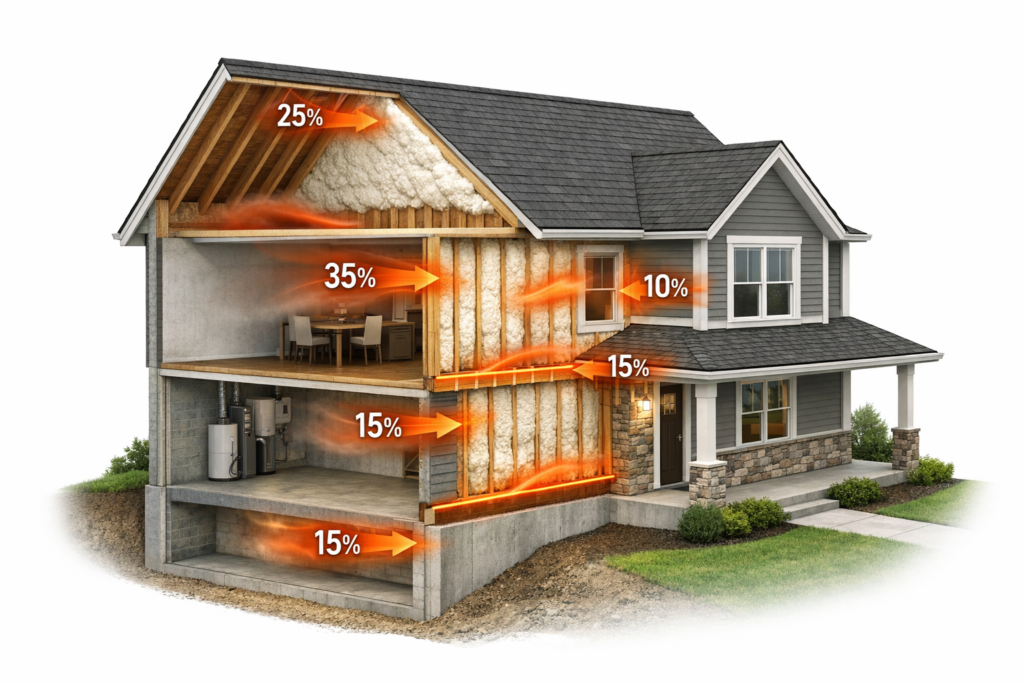
Heat loss in a home is not evenly distributed—it occurs through specific areas where air movement and weak insulation allow energy to escape.
In many homes, air leakage alone can account for a significant portion of heat loss, while areas like basements, walls, windows, and attics also contribute depending on construction and sealing quality.
Understanding where heat is lost helps identify the most effective areas to improve insulation and reduce energy waste.
See Exactly Where You’re Losing Heat →
Heat loss in a home is not random—it follows predictable patterns based on how air moves, how materials conduct heat, and how the structure is built.
Understanding these loss points helps explain why some homes feel drafty, inconsistent, or expensive to heat.
🔹 1. Air Leakage (30% – 40%) — THE BIGGEST LOSS
The largest portion of heat loss does not happen through walls or insulation—it happens through uncontrolled air movement.
This includes:
• gaps around windows and doors
• cracks in walls and ceilings
• openings around plumbing, wiring, and vents
• poorly sealed joints in framing
Even small gaps can allow warm air to escape and cold air to enter.
👉 This is why homes feel drafty, even when insulated.
🔹 2. Walls (15% – 25%)
Exterior walls lose heat through both:
• conduction (heat passing through materials)
• air leakage inside cavities
Poorly insulated or older walls can significantly reduce energy efficiency.
🔹 3. Basement & Foundation (20% – 30%)
Basements are one of the most overlooked heat loss areas.
Concrete walls and foundations:
• absorb heat from the home
• transfer it into the ground
• allow cold air infiltration
In many homes, basements alone account for up to one-third of total heat loss.
🔹 4. Windows & Doors (10% – 20%)
Heat escapes through:
• glass surfaces (low insulation value)
• gaps around frames
• poor sealing or aging materials
Even modern windows can contribute to heat loss if not properly sealed.
🔹 5. Attic / Roof (10% – 25%)
Warm air naturally rises, making the attic a key escape point.
However, actual loss depends on:
• insulation level
• air sealing quality
• ventilation design
👉 In many cases, heat escapes through gaps before insulation even matters
🔹 What This Means for Your Home
Most heat loss is not just about insulation—it is about air movement + weak sealing.
That is why:
• adding insulation alone does not always solve the problem
• sealing gaps can have a bigger impact than increasing R-value
• the building must be treated as a system, not isolated parts
This is also why solutions like spray foam—which combine insulation and air sealing—are often used in high-performance buildings.
BEST AREAS TO USE SPRAY FOAM
Spray foam delivers the greatest value in areas where air leakage, moisture exposure, and complex construction make traditional insulation less effective.
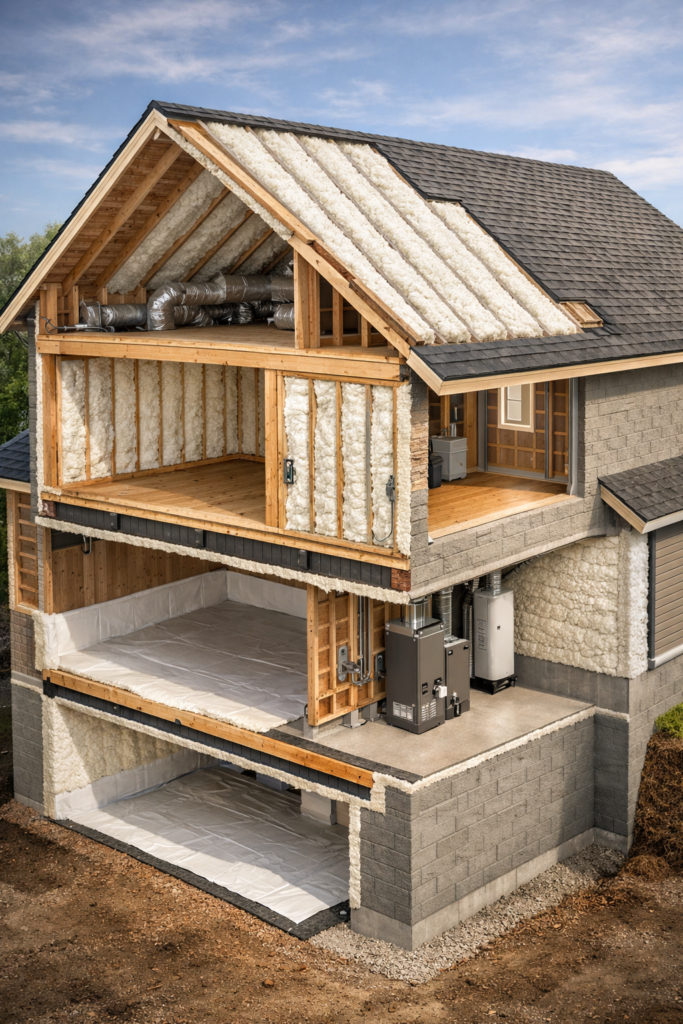
Key areas such as attics, basements, rim joists, crawlspaces, and hard-to-reach spaces often experience the highest energy loss due to gaps and poor sealing.
By expanding into these difficult areas and creating a continuous barrier, spray foam helps improve performance where it matters most.
See Where It Works Best →
Spray foam is not always necessary everywhere—but in certain areas, it significantly outperforms traditional insulation because of its ability to both insulate and seal air leaks.
🔹 1. Attics — Highest Impact Area
Attics are one of the largest sources of heat loss due to rising warm air (stack effect).
Common problems:
• gaps around wiring, vents, and top plates
• uneven or compressed insulation
• air escaping before insulation can perform
Spray foam helps by:
• sealing all leakage points
• maintaining insulation continuity
• reducing heat escape at the top of the home
👉 This is often the first place to upgrade for maximum energy savings
🔹 2. Rim Joists — Hidden Leakage Zone
Rim joists (where floors meet exterior walls) are one of the most overlooked air leakage areas.
Common issues:
• multiple joints and seams
• difficult-to-reach spaces
• poor sealing with traditional insulation
Spray foam is ideal here because it:
• expands into tight gaps
• seals structural transitions
• blocks airflow at critical junctions
🔹 3. Basements & Foundations — Continuous Heat Loss
Basements can account for 20–30% of total heat loss.
Challenges include:
• cold concrete surfaces
• moisture exposure
• air leakage through cracks and penetrations
Spray foam helps by:
• insulating directly against foundation walls
• reducing moisture movement
• creating a continuous thermal barrier
🔹 4. Crawlspaces — Air + Moisture Control
Crawlspaces are prone to:
• cold air infiltration
• humidity buildup
• poor insulation coverage
Spray foam addresses both:
• air sealing
• moisture resistance
This helps improve overall indoor air quality and comfort.
🔹 5. Walls with Limited Space
In areas where wall thickness is limited, higher R-value per inch becomes important.
Closed-cell spray foam provides:
• higher insulation in thinner layers
• better performance where space is constrained
🔹 6. Complex or Hard-to-Reach Areas
Traditional insulation struggles in areas like:
• irregular framing
• corners and joints
• areas with pipes, ducts, and wiring
Spray foam expands to:
• fill irregular spaces
• eliminate gaps
• maintain consistent coverage
🔹 Practical Takeaway
Spray foam is most valuable where:
• air leakage is high
• geometry is complex
• insulation continuity is difficult
These are typically the areas where homeowners experience:
• drafts
• uneven temperatures
• higher energy bills
SOUNDPROOFING BENEFITS
Spray foam can help make a home quieter, but its role in sound control depends on the type of foam used and the way the wall or ceiling system is built.
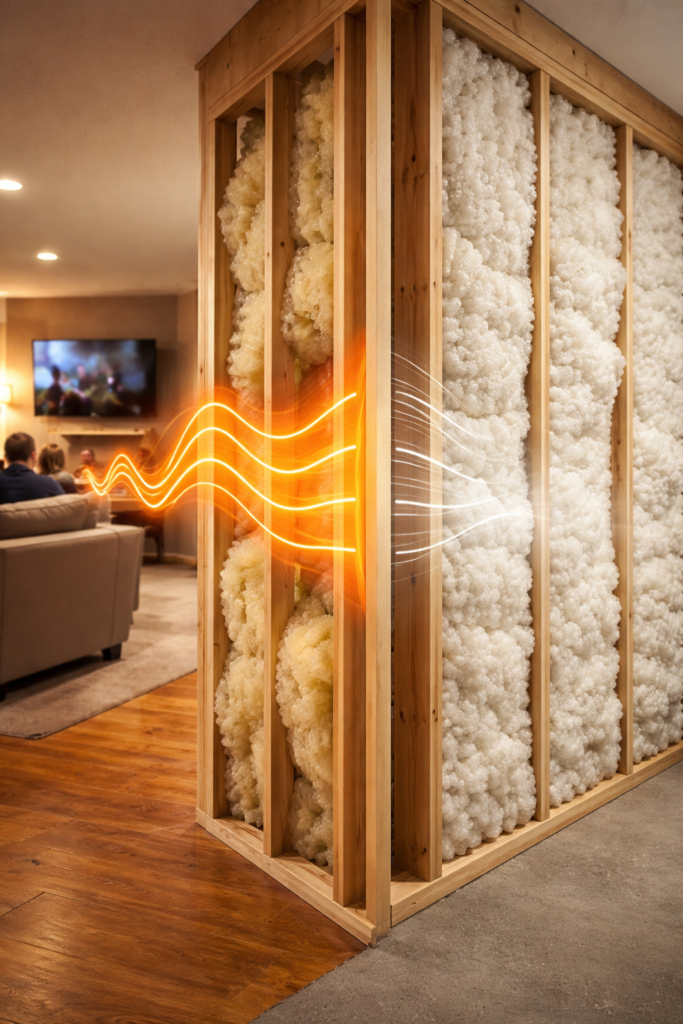
Open-cell spray foam, with its softer and more porous structure, is better suited for absorbing sound within cavities and reducing echo or general noise transfer inside a building. Closed-cell foam can help reduce air movement, but it is not typically chosen for sound absorption in the same way.
That said, insulation alone does not fully soundproof a room. True sound isolation depends on the full assembly—including airtightness, added mass, and structural design. Spray foam improves acoustic comfort, but it works best as part of a broader sound-control strategy rather than a standalone soundproofing solution.
Understand Sound Control in Depth →
Sound behaves differently from heat, and controlling it requires understanding how it travels through structures.
🔹 Sound Absorption vs Sound Blocking
There are two fundamental ways to manage sound in a building:
Sound Absorption (within a space)
This reduces echo and reverberation by absorbing sound waves inside a room.
Sound Blocking / Isolation (between spaces)
This prevents sound from traveling from one room to another.
Spray foam primarily contributes to absorption and partial reduction in sound transmission—but not complete sound isolation.
🔹 How Spray Foam Improves Sound Comfort
Spray foam helps control sound in several ways:
• fills gaps and cracks where sound can travel
• reduces air pathways that carry noise
• dampens sound waves inside cavities
• improves overall airtightness of the assembly
Because sound often travels through air gaps, sealing those gaps can noticeably reduce noise transmission.
🔹 Open-Cell vs Closed-Cell Performance
Open-Cell Spray Foam:
• porous and flexible structure
• better at absorbing sound waves
• commonly used in interior partitions
• helps reduce echo and internal noise
Closed-Cell Spray Foam:
• denser and more rigid
• reduces airflow but reflects more sound
• provides limited sound absorption compared to open-cell
Open-cell foam is generally preferred when sound control is a priority.
🔹 What It Cannot Do Alone
Spray foam alone cannot fully “soundproof” a space.
Effective sound isolation requires a combination of:
• cavity insulation (for absorption)
• airtight construction (to eliminate sound paths)
• added mass (such as drywall layers)
• structural decoupling (to prevent vibration transfer)
Sound performance is measured at the assembly level (STC rating), not by a single material.
🔹 Where You’ll Notice the Difference
Spray foam can improve acoustic comfort in:
• bedrooms and living areas
• home offices and workspaces
• shared walls in multi-family homes
• mechanical or utility rooms
It is especially effective when combined with proper wall construction techniques.
🔹 Practical Takeaway
Spray foam helps reduce noise and improve comfort, but it should be viewed as one part of a broader sound-control strategy rather than a complete soundproofing solution.
SIGNS YOUR INSULATION NEEDS REPLACEMENT
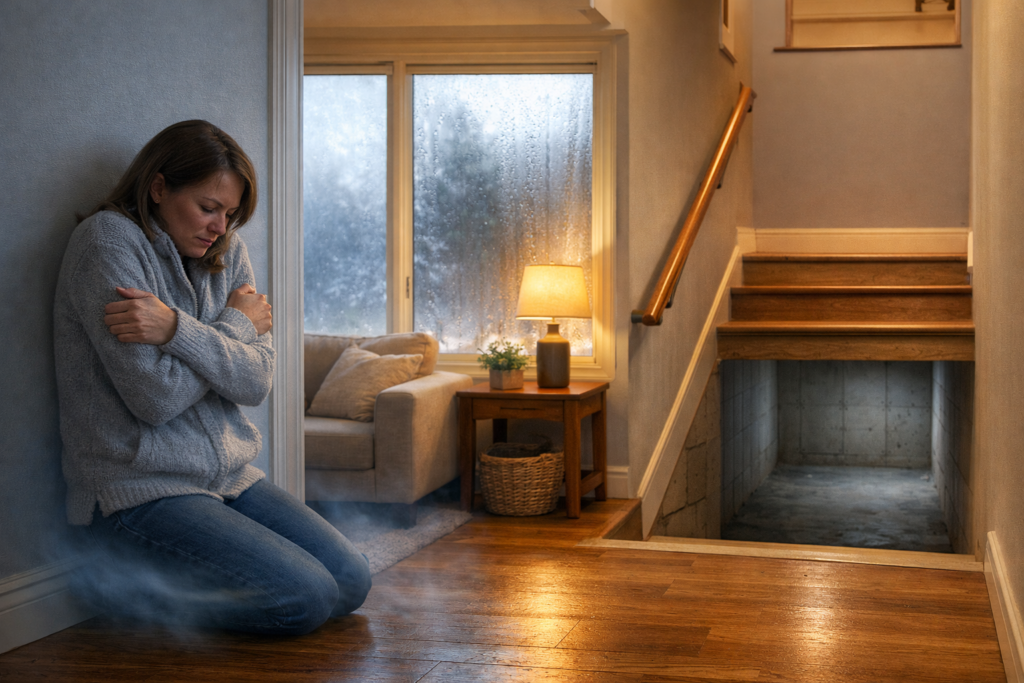
Insulation problems rarely show up as obvious damage—they appear through subtle but consistent issues in comfort, energy use, and indoor conditions.
If your home feels drafty, has uneven temperatures between rooms or floors, or your energy bills continue to rise without clear reason, it is often a sign that heat is escaping through gaps, poorly sealed areas, or underperforming insulation.
In many homes, up to 25–40% of heat loss can occur through air leakage alone, while basements, walls, and windows can contribute significantly to overall energy loss.
Other warning signs include cold floors or walls, moisture buildup, condensation, or musty odors—indicating that insulation is not only failing to retain heat but also allowing unwanted air and moisture movement.
Recognizing these signs early helps prevent higher energy costs, improves indoor comfort, and protects the long-term condition of the building.
Check If Your Insulation Is Failing →
Insulation problems rarely show up as a single issue—they appear as patterns across comfort, energy use, and building condition.
Understanding these signs helps identify when insulation is no longer performing effectively.
🔹 1. Uneven Temperatures Throughout the Home
One of the most common signs is inconsistent temperature between rooms or floors.
You may notice:
• certain rooms always feel colder or hotter
• upper floors overheating in summer or losing heat in winter
• difficulty maintaining a stable indoor temperature
This often indicates:
• air leakage between levels (stack effect)
• gaps or discontinuity in insulation
🔹 2. Drafts Despite Closed Windows and Doors
If you feel air movement indoors even when everything is closed, it is typically due to leakage within the building envelope—not outside openings.
Common sources include:
• gaps in walls or ceilings
• poorly sealed attic bypasses
• rim joists and structural transitions
Air leakage alone can account for 25%–40% of total heat loss in many homes, especially older ones
👉 This is often mistaken as “bad insulation” when it is actually air movement.
🔹 3. Rising Energy Bills Without Clear Reason
A steady increase in heating or cooling costs often signals declining insulation performance.
This can be caused by:
• insulation settling or shifting
• gaps forming over time
• air bypassing insulation layers
Even small inefficiencies compound over time, increasing HVAC workload and energy consumption.
🔹 4. Cold Floors, Walls, or Basement Areas
Surfaces that feel consistently cold are a strong indicator of heat loss through conduction and poor insulation.
Basements are especially important:
• can account for ~20%–35% of total heat loss
• often have both insulation gaps and air leakage
Cold floors above garages or crawlspaces are also common problem areas.
🔹 5. Moisture, Condensation, or Musty Odors
Insulation issues are often linked to moisture problems.
Signs include:
• condensation on windows or walls
• damp smells in basements or crawlspaces
• visible mold or staining
Air leakage can carry significant moisture into building assemblies, where it condenses on cold surfaces
👉 This is not just a comfort issue—it can affect structural durability.
🔹 6. Ice Dams or Roof Issues in Winter
Ice buildup along roof edges is often caused by heat escaping into the attic.
This happens when:
• warm air leaks upward
• melts snow unevenly
• refreezes at colder roof edges
This is a direct sign of poor air sealing and insulation continuity.
🔹 7. Insulation That Looks Disturbed or Incomplete
In accessible areas (like attics), you may notice:
• compressed or uneven insulation
• gaps between sections
• areas around vents or wiring left exposed
Traditional insulation relies heavily on perfect installation—any gap reduces effectiveness.
🔹 Practical Takeaway
Insulation failure is rarely about one issue—it is usually a combination of:
• air leakage
• incomplete coverage
• aging or disturbed materials
If multiple signs are present, it often indicates that the insulation system is no longer performing as intended.
GOOD VS BAD INSTALLATION
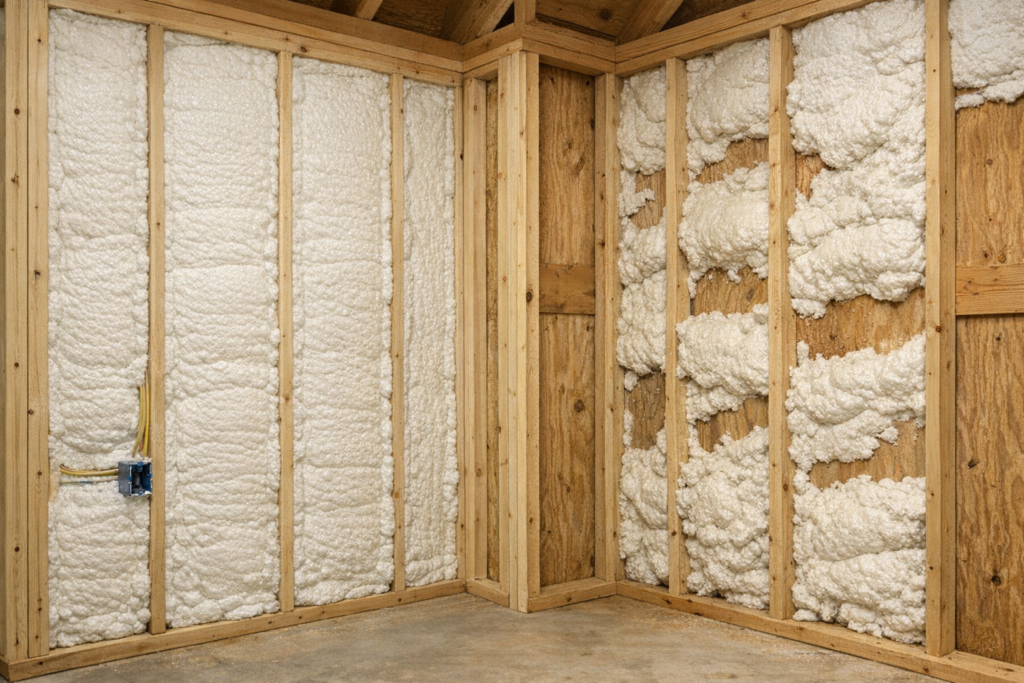
The performance of spray foam insulation depends heavily on how it is installed. Even high-quality material can underperform if application is inconsistent, incomplete, or done under improper conditions.
A well-installed system creates a continuous, properly cured insulation layer with no gaps or weak points. Poor installation, on the other hand, can lead to reduced efficiency, air leakage, odor issues, and long-term performance problems.
Understanding the difference between good and bad installation helps ensure that the insulation delivers the comfort, durability, and energy savings it is designed for.
See What Proper Installation Looks Like →
Spray foam insulation is highly dependent on installation quality because it is applied on-site and becomes part of the building structure.
Unlike pre-formed insulation materials, its effectiveness depends on coverage, thickness, curing conditions, and continuity.
🔹 What Good Installation Looks Like
A properly installed spray foam system should demonstrate:
• Continuous coverage across all surfaces with no missed areas
• Uniform thickness based on design requirements
• Strong adhesion to wood, concrete, or metal surfaces
• Smooth, consistent finish without voids or gaps
• Correct application in layers to allow proper curing
Good installation also ensures that transitions—such as rim joists, corners, and penetrations—are fully sealed, maintaining an uninterrupted air barrier.
🔹 What Poor Installation Looks Like
Installation issues can significantly reduce performance and may lead to future problems.
Common signs include:
• Gaps or missed areas where foam was not applied
• Uneven thickness, leading to inconsistent insulation performance
• Foam pulling away from studs or surfaces after curing
• Over-expansion or shrinkage, indicating improper mixing or conditions
• Lingering strong odor, suggesting incomplete curing
These issues break the continuity of the insulation and allow air leakage, reducing effectiveness.
🔹 Why Installation Quality Matters
Spray foam works as a system. If any part of that system is incomplete, performance is compromised.
Poor installation can result in:
• reduced energy efficiency
• uncomfortable indoor temperatures
• moisture movement and potential condensation issues
• the need for costly corrections or rework
Because spray foam combines insulation and air sealing, even small defects can have a noticeable impact.
🔹 Conditions That Affect Installation
Proper installation also depends on site conditions such as:
• surface preparation and cleanliness
• temperature and humidity levels
• correct mixing and application technique
• controlled application thickness per pass
Installers must follow manufacturer guidelines to ensure proper curing and long-term performance.
🔹 Practical Takeaway
The material alone does not determine performance—the installation does.
Choosing experienced installers and ensuring proper application conditions is critical to getting the full benefit of spray foam insulation.
PREPARING YOUR SPACE FOR INSTALLATION
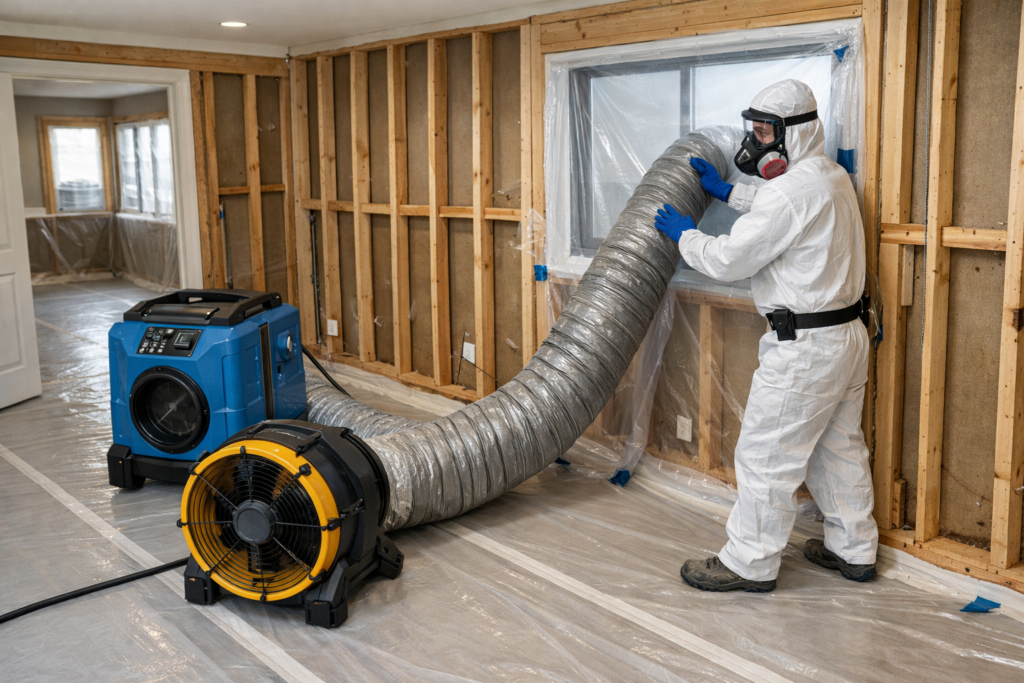
Proper preparation plays an important role in ensuring a smooth and effective spray foam installation. Because the process involves on-site application, controlled conditions, and curing time, the space must be ready before work begins.
Homeowners may need to clear access to work areas, protect belongings, and plan temporary relocation during installation and curing. Taking these steps in advance helps ensure safety, proper application, and better overall results.
Prepare Your Home the Right Way →
Spray foam installation is different from traditional insulation because it is applied directly on-site and undergoes a chemical reaction as it expands and cures.
Proper preparation helps ensure both safety and performance.
🔹 1. Clear and Access the Work Area
Before installation, the area should be fully accessible.
This may include:
• removing stored items from attics or basements
• clearing wall or ceiling access in renovation areas
• ensuring installers can reach all surfaces easily
Unobstructed access helps achieve continuous and even application.
🔹 2. Protect Surfaces and Belongings
Although professional installers take precautions, nearby surfaces should be protected.
Consider:
• covering floors, furniture, or equipment
• removing sensitive items from the work zone
• isolating areas not being treated
This helps prevent accidental overspray or dust during trimming.
🔹 3. Plan Temporary Vacating of the Space
During installation and curing, it is generally recommended that occupants and pets leave the property.
Typical guidance includes:
• vacating during application
• allowing adequate curing and ventilation time before re-entry
• following installer-specific recommendations
Re-entry timelines can vary, but many systems require a controlled period for safe occupancy after installation.
🔹 4. Ensure Proper Ventilation and Isolation
Installers will typically:
• isolate the work area
• use ventilation equipment
• manage airflow during application
Proper ventilation helps remove vapors and supports safe curing conditions.
🔹 5. Coordinate Timing and Conditions
Installation quality depends on site conditions such as:
• temperature and humidity levels
• surface readiness (clean and dry)
• scheduling to avoid interruptions
These factors help ensure proper expansion, adhesion, and curing of the foam.
🔹 6. Communicate With Your Installer
Before work begins, it is helpful to clarify:
• scope of work and areas being treated
• expected duration of installation
• re-entry timing and safety guidelines
• any specific preparation required for your home
Clear communication ensures expectations are aligned.
🔹 Practical Takeaway
Preparation is not just about convenience—it directly impacts safety, installation quality, and final results.
A well-prepared space allows installers to apply spray foam correctly and helps ensure the system performs as intended.

ENERGY SAVINGS
Energy savings from insulation come from reducing how much heated or cooled air escapes the home. In many houses, a significant portion of energy loss is caused not just by poor insulation, but by air leakage through gaps, cracks, and unsealed areas.
By combining insulation with air sealing, spray foam helps reduce this energy loss more effectively than materials that only slow heat transfer. This can lead to lower heating and cooling costs, improved temperature consistency, and reduced strain on HVAC systems.
Actual savings vary based on the home, but improving insulation and sealing key areas can make a noticeable difference in overall energy use.
See How Savings Add Up →
Energy efficiency in a home is influenced by how well it retains conditioned air and resists heat transfer.
Spray foam improves both of these factors.
🔹 1. Reducing Energy Loss at the Source
A large portion of heat loss in homes occurs through uncontrolled air movement.
Air leakage can account for 25%–40% of total heat loss, especially in older or less airtight homes.
When warm air escapes in winter—or hot air enters in summer—heating and cooling systems must work harder to maintain comfort.
🔹 2. Insulation + Air Sealing Together
Traditional insulation materials primarily slow heat transfer but do not stop air movement.
Spray foam:
• fills gaps and cracks
• seals leakage points
• reduces airflow through the building envelope
This combined effect improves real-world efficiency beyond insulation alone.
🔹 3. Lower Heating and Cooling Demand
By reducing energy loss, spray foam helps:
• maintain stable indoor temperatures
• reduce the frequency of HVAC cycling
• lower overall heating and cooling demand
This can extend equipment life and improve overall system efficiency.
🔹 4. Realistic Savings Expectations
Energy savings vary depending on:
• age and condition of the home
• existing insulation levels
• amount of air leakage
• areas being upgraded
In many cases, improving insulation and air sealing in key areas can result in measurable reductions in energy costs, especially when addressing high-loss zones like attics, basements, and rim joists.
🔹 5. Long-Term Performance
Because spray foam adheres to surfaces and does not settle, it maintains its performance over time.
This helps ensure that energy savings are:
• consistent
• long-term
• less dependent on maintenance
🔹 Practical Takeaway
Energy savings are not just about adding more insulation—they come from controlling how air and heat move through the home.
Addressing both factors together leads to more reliable and noticeable improvements in efficiency.
MOISTURE AND MOLD PROTECTION
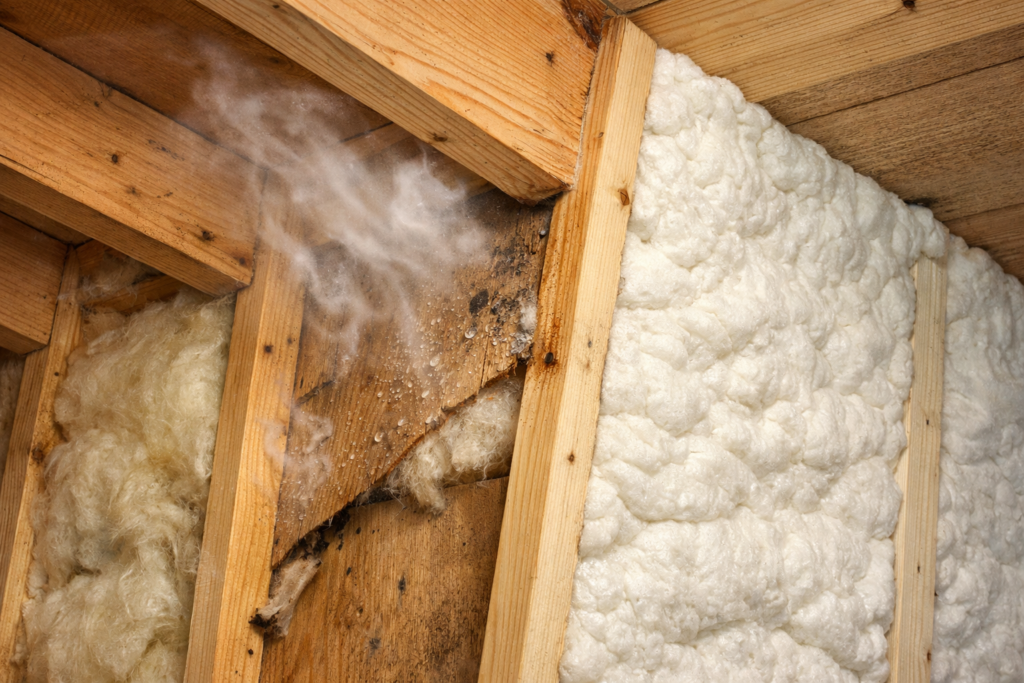
Moisture problems in homes are often caused by uncontrolled air movement, not just visible water leaks. Warm air carrying moisture can enter walls, ceilings, and basements, where it condenses on colder surfaces and creates conditions for mold growth.
Proper insulation helps control this by limiting both heat transfer and air leakage. By reducing the movement of moisture-laden air, spray foam can help protect building materials, improve indoor air quality, and reduce the risk of long-term damage.
The effectiveness of moisture control depends on the type of foam used and how the overall building system is designed.
Understand Moisture Control →
Moisture control is a key part of building performance, especially in colder climates where temperature differences drive condensation.
🔹 1. How Moisture Moves in a Home
Moisture travels in two main ways:
• through air movement (air leakage)
• through material diffusion (slower process)
In most homes, air movement carries far more moisture than diffusion, meaning even small gaps can introduce significant moisture into wall and ceiling assemblies.
🔹 2. Why Condensation Happens
Condensation occurs when warm, moisture-laden air comes into contact with a cold surface.
Common problem areas include:
• exterior walls in winter
• attic surfaces
• basement walls and floors
Over time, repeated condensation can lead to:
• mold growth
• material deterioration
• reduced insulation effectiveness
🔹 3. How Spray Foam Helps
Spray foam reduces moisture risk by limiting the movement of air that carries water vapor.
It helps by:
• sealing gaps where moist air can enter
• reducing temperature differences across surfaces
• maintaining more stable indoor conditions
Closed-cell spray foam can also provide additional resistance to moisture in certain applications, particularly in basements or below-grade areas.
🔹 4. Open-Cell vs Closed-Cell and Moisture
Open-cell foam:
• allows some vapor permeability
• can support drying in certain wall assemblies
Closed-cell foam:
• more resistant to moisture absorption
• can act as a vapor barrier at sufficient thickness
The right choice depends on the location and design of the building assembly.
🔹 5. The Role of Ventilation
As homes become more airtight, managing indoor humidity becomes important.
Proper ventilation helps:
• control indoor moisture levels
• prevent condensation on windows and surfaces
• maintain healthy indoor air quality
Moisture control works best when insulation, air sealing, and ventilation are considered together.
🔹 Practical Takeaway
Moisture problems are often driven by air leakage, not just visible water intrusion.
Controlling air movement is one of the most effective ways to reduce condensation, protect building materials, and prevent mold-related issues over time.

REBATES AND INCENTIVES
Government rebates and incentives can significantly reduce the cost of insulation upgrades while improving long-term energy savings.
In Ontario, current programs can cover up to 30% of renovation costs or provide rebates ranging from $1,500 to $10,000, depending on the scope of work and home type. National programs like the Canada Greener Homes Grant previously offered up to $5,000 and have now transitioned into new affordability-focused programs.
When combined with energy savings—often 10% to 40% reduction in heating and cooling costs depending on the home—these incentives can substantially improve the return on investment for insulation upgrades.
Understanding available programs, eligibility requirements, and timelines helps homeowners maximize both immediate rebates and long-term savings.
See Savings, Rebates & Programs →
Energy efficiency upgrades are supported by both national and provincial programs in Canada, designed to reduce energy consumption and make home improvements more affordable.
🔹 1. National Programs (Canada-Wide)
Canada Greener Homes Grant (Launched 2021 – Closed 2025)
• Provided up to $5,000 in grants for insulation and energy upgrades
• Covered attic, wall, basement insulation and air sealing
• Required pre- and post-energy audits
What replaced it:
• New affordability-focused programs expected (2026 onward) targeting low-to-middle income households
Canada Greener Homes Loan (Active)
• Up to $40,000 interest-free financing for upgrades
• Helps cover upfront cost while savings offset payments
🔹 2. Ontario Provincial Programs
Home Renovation Savings Program (Launched January 2025)
• Covers up to 30% of renovation costs
• Total rebates:
- Up to $5,000 (gas homes)
- Up to $10,000 (electric/other homes)
Typical rebate breakdown:
• Attic insulation: up to ~$1,500
• Basement insulation: up to ~$3,500
• Wall insulation: up to ~$3,600
• Air sealing: ~$250–$2,100
• Energy audit: ~$600 reimbursement
👉 Some streams require:
• energy audit
• multiple upgrades
👉 Others (like attic-only) may not require audits
🔹 3. Previous Ontario Programs (Context)
Home Efficiency Rebate (Launched 2024)
• Up to $5,000 in rebates
• Replaced by newer 2025 program
👉 This shows:
Programs evolve—but incentives continue
🔹 4. Real Energy Savings (What Homeowners Actually Save)
Savings depend on home condition, but research-backed ranges show:
• Air leakage alone can account for 25–40% of heat loss
• Fixing insulation + sealing can reduce energy use by ~10%–15% on average
• In poorly insulated homes, savings can reach 20%–40%
👉 Example:
If a home spends:
• $2,400/year on heating & cooling
Potential savings:
• 15% savings → ~$360/year
• 30% savings → ~$720/year
🔹 5. Combined Financial Impact (Realistic Scenario)
Example retrofit:
• Insulation upgrade cost: $8,000
• Rebate received: $3,000–$5,000
• Net cost: $3,000–$5,000
Annual savings:
• $300–$700/year
👉 Payback period:
• ~4 to 8 years
After that:
• continued savings + improved comfort
🔹 6. Why Spray Foam Maximizes ROI
Spray foam can improve return because it:
• combines insulation + air sealing in one application
• reduces need for multiple upgrades
• maintains performance long-term (no settling)
👉 This helps capture:
• insulation rebates
• air sealing benefits
• long-term energy savings
🔹 Practical Takeaway
Rebates reduce upfront cost.
Energy savings reduce long-term cost.
When combined, they significantly improve the value of insulation upgrades—especially when targeting high-loss areas like attics, basements, and air leakage points.
SPRAY FOAM SAFETY
Spray foam insulation is safe when properly installed and fully cured, but the installation process requires controlled conditions, professional handling, and temporary precautions.
During application, the material undergoes a chemical reaction and releases vapors that require the area to be ventilated and occupants to vacate for a defined period. Most professional installations recommend staying out of the space for approximately 24 hours, depending on the product and site conditions.
Once cured, spray foam becomes an inert material that does not continue to release harmful emissions under normal conditions. Understanding the difference between the installation phase and post-installation performance helps ensure safety while maintaining confidence in long-term use.
Understand Safety & Best Practices →
Spray foam insulation safety is best understood in two phases: installation and curing, and post-installation performance.
🔹 1. During Installation (Active Application Phase)
Spray foam is created by mixing two components that react and expand on contact.
During this process:
• vapors and aerosols are released
• installers use full protective equipment
• the work area is isolated and ventilated
For safety, occupants and pets should leave the property during installation.
🔹 2. Curing and Re-Entry
After application, the foam needs time to cure and off-gas.
Typical guidance:
• allow proper ventilation of the space
• follow installer and product-specific recommendations
• re-entry is often recommended after ~24 hours, but may vary
Sensitive individuals (children, elderly, or those with respiratory conditions) may require additional caution.
🔹 3. After Curing (Long-Term Safety)
Once fully cured, spray foam becomes stable and inert.
At this stage:
• it no longer emits active vapors
• it remains fixed in place without movement
• it functions as part of the building structure
Under normal conditions, properly installed foam does not pose ongoing exposure concerns.
🔹 4. Importance of Proper Installation
Most safety concerns arise from poor installation practices.
Potential issues include:
• incomplete curing due to improper mixing
• strong or persistent odor beyond expected timeframe
• gaps or defects affecting performance
These risks are minimized when:
• installation follows manufacturer guidelines
• proper ventilation is used
• experienced installers ensure correct application
🔹 5. Fire Safety and Building Requirements
Spray foam insulation must be protected when used inside living spaces.
In most cases:
• it is covered with a thermal barrier (such as drywall)
• it should not be left exposed in occupied areas
• it must meet local building code requirements
This ensures safe integration into the building system.
🔹 6. Practical Safety Guidelines for Homeowners
Before installation:
• confirm re-entry timelines with your installer
• plan temporary relocation if required
After installation:
• ensure the space has been ventilated
• check for any unusual or persistent odors
• verify that all work areas are properly finished
🔹 Practical Takeaway
Spray foam is safe when installed correctly and allowed to cure under proper conditions.
Understanding the process—and following recommended precautions—ensures both short-term safety and long-term performance.

FREQUENTLY ASKED QUESTIONS
Spray foam insulation often raises important questions around cost, safety, performance, and long-term value. Understanding these common concerns helps homeowners make more informed decisions and set realistic expectations.
From how long it lasts to whether it is worth the investment, most questions come down to how spray foam performs in real homes compared to traditional insulation.
This section addresses the most common questions homeowners ask before moving forward with an insulation upgrade.
FOUNDATIONS →
🔹 1. What is spray foam insulation?
Spray foam insulation is a material we at SprayZo apply as a liquid that expands on contact, filling gaps, cracks, and cavities within a building.
But more importantly, it is not just insulation—it is a system that changes how your home handles air and heat.
Instead of simply slowing heat movement like traditional materials, spray foam creates a continuous barrier that helps control:
• where air enters and escapes
• how heat moves through the structure
• how consistent indoor temperatures remain
That’s why it performs differently in real-world conditions.
🔹 2. How does spray foam insulation work?
When we install spray foam, we apply a two-component liquid that reacts and expands rapidly—often many times its original size.
As it expands, it:
• fills irregular spaces that traditional insulation cannot reach
• adheres directly to surfaces like wood, concrete, and metal
• seals gaps where air typically leaks
This creates a continuous layer that reduces:
• heat transfer
• air leakage
• moisture movement carried by air
So instead of relying on perfect placement, we create a sealed system.
🔹 3. What is SPF?
SPF stands for Spray Polyurethane Foam.
It refers to a category of insulation materials we use that expand during application and form both an insulation layer and an air barrier.
At SprayZo, we primarily work with two types:
• open-cell foam (lighter, more flexible)
• closed-cell foam (denser, higher performance)
Each is used based on the specific needs of the space.
🔹 4. What is the difference between spray foam and regular insulation?
The key difference is what happens to air.
Traditional insulation (like fiberglass):
• slows heat transfer
• does not stop air movement
• depends heavily on perfect installation
Spray foam:
• insulates and seals at the same time
• blocks air leakage at the source
• adapts to irregular spaces
We at SprayZo often explain it this way:
👉 Fiberglass tries to manage heat
👉 Spray foam controls both heat and air
That difference shows up in real performance.
🔹 5. Why is spray foam considered different from fiberglass or cellulose?
Because it solves a problem those materials don’t fully address—air leakage.
Fiberglass and cellulose can perform well under ideal conditions, but in real homes:
• gaps are common
• installation is rarely perfect
• materials can shift or compress over time
Spray foam:
• expands into those gaps
• bonds to surfaces
• stays in place long-term
So instead of relying on precision alone, we build in consistency.
🔹 6. Does spray foam only insulate, or does it also air seal?
It does both—and that’s the core value.
When we install spray foam, we are:
• reducing heat flow through materials (insulation)
• stopping uncontrolled air movement (air sealing)
In many homes, air leakage accounts for a large portion of energy loss.
So when we seal those pathways, we are not just improving insulation—we are improving how the entire home performs.
🔹 7. What problems does spray foam actually solve in a building?
We at SprayZo usually install spray foam to solve very specific, real-world problems:
• cold drafts even when heating is on
• uneven temperatures between rooms or floors
• high energy bills without clear explanation
• moisture moving into walls or ceilings
• discomfort in areas like basements or above garages
Instead of treating symptoms, we focus on the root cause—how air and heat move through the building.
🔹 8. Is spray foam meant for new construction, renovations, or both?
Both—and the approach changes depending on the project.
In new construction:
• we build a tighter, more efficient structure from the start
• we control air movement before it becomes a problem
In renovations:
• we target high-loss areas first
• we improve performance without needing full reconstruction
We at SprayZo often recommend a targeted approach for existing homes to maximize impact.
🔹 9. Is spray foam used only in homes, or also in commercial buildings?
We use spray foam in both residential and commercial projects.
In homes, the focus is usually:
• comfort
• energy efficiency
• moisture control
In commercial settings, it’s often used for:
• large open structures
• temperature regulation
• condensation control
• reducing operating costs
The principles are the same—the scale and priorities just differ.
🔹 10. Where is spray foam most commonly installed?
We at SprayZo focus on areas where:
👉 heat loss is highest
👉 air leakage is most common
These typically include:
• attics (top of the building envelope)
• rim joists (structural transition points)
• basements and foundation walls
• crawlspaces
• problem wall sections
Instead of applying it everywhere, we prioritize areas where it delivers the most value first.
OPEN-CELL VS CLOSED-CELL →
🔹 11. What is the difference between open-cell and closed-cell spray foam?
The difference comes down to structure, density, and application purpose.
Open-cell foam:
• lighter and softer
• expands more aggressively
• better at filling large cavities and absorbing sound
Closed-cell foam:
• denser and more rigid
• higher insulation value per inch
• more resistant to moisture
We at SprayZo choose between them based on performance needs—not just cost.
🔹 12. Which is better: open-cell or closed-cell spray foam?
There is no one-size-fits-all answer.
We determine what’s “better” based on:
• where the foam is being installed
• how much space is available
• whether moisture is a concern
• whether sound control is important
In many projects, the best solution is actually a combination of both.
🔹 13. When should open-cell foam be used?
We at SprayZo typically recommend open-cell foam for:
• interior walls
• sound control applications
• large cavities where expansion helps full coverage
Because it expands more, it helps fill irregular spaces efficiently and improves acoustic comfort.
🔹 14. When should closed-cell foam be used?
Closed-cell foam is used when higher performance is required.
We recommend it for:
• basements and foundation walls
• crawlspaces
• exterior-facing walls
• areas with limited thickness
It is especially useful where moisture control and higher R-value are important.
🔹 15. Is closed-cell foam worth the extra cost?
In the right scenario, yes—and in others, not necessary.
We at SprayZo recommend closed-cell when:
• space is limited but performance needs are high
• moisture exposure is a concern
• long-term durability is critical
If those conditions don’t apply, open-cell may deliver better value.
🔹 16. Which type gives higher R-value per inch?
Closed-cell foam provides higher R-value per inch—typically around R-6 to R-7 per inch, compared to ~R-3.5 to R-4 per inch for open-cell.
This matters when:
• wall depth is limited
• higher thermal performance is required in a thinner layer
🔹 17. Which type is better for sound control?
Open-cell foam performs better for sound absorption.
Its softer structure helps absorb sound waves within cavities, which:
• reduces echo
• improves acoustic comfort
• slightly limits sound transfer
Closed-cell foam is denser but not designed for sound absorption in the same way.
🔹 18. Which type is better for moisture-prone areas?
Closed-cell foam is the better choice in moisture-prone environments.
We use it in areas like:
• basements
• crawlspaces
• foundation walls
Because it:
• resists water absorption
• provides a tighter seal
• performs well against concrete
🔹 19. Which type is better for basements?
In most cases, we at SprayZo recommend closed-cell foam for basements.
Basements involve:
• colder surfaces
• higher humidity levels
• potential moisture exposure
Closed-cell foam handles these conditions more reliably and helps create a more stable environment.
🔹 20. Can a project use both open-cell and closed-cell foam?
Yes—and that is often the best approach.
For example:
• closed-cell in basements or exterior-facing areas
• open-cell in interior walls or large cavities
This allows us to optimize performance while managing cost effectively.
PERFORMANCE & COMFORT →
🔹 21. Will spray foam make my house warmer in winter?
Yes—but more accurately, it helps your home hold heat longer and more consistently.
We at SprayZo reduce heat loss and air leakage, which means:
• your heating system runs more efficiently
• indoor temperatures stay stable
• you feel more comfortable with less fluctuation
🔹 22. Will spray foam make my house cooler in summer?
Yes—by reducing how much heat enters your home.
We control:
• heat transfer through materials
• hot air entering through gaps
This helps maintain cooler indoor temperatures and reduces reliance on air conditioning.
🔹 23. Will spray foam stop drafts completely?
In most cases, it significantly reduces or eliminates drafts.
Drafts are usually caused by uncontrolled air movement. When we seal those pathways, the effect is immediate.
However, total airtightness depends on the full building—not just one area.
🔹 24. Why do some homes still feel uncomfortable even with insulation?
Because insulation alone is not enough.
Many homes have insulation installed, but still experience:
• air leakage
• uneven coverage
• gaps around structural elements
We at SprayZo address both insulation and air sealing, which is why the results feel different.
🔹 25. Can spray foam make temperatures more even between rooms?
Yes—and this is one of the most noticeable improvements.
By reducing air movement and improving insulation continuity, we help:
• eliminate hot and cold spots
• stabilize temperatures across floors
• improve overall comfort
This is especially important in multi-level homes or problem areas.
🔹 26. Will floors feel warmer after installation?
In many cases, yes—and this is something homeowners notice quickly.
Cold floors usually happen because heat is escaping downward into basements, crawlspaces, or uninsulated areas. We at SprayZo typically address this by insulating and sealing those lower-level surfaces.
Once heat loss is reduced, floors feel more neutral instead of cold, especially in winter.
🔹 27. Will spray foam help rooms above garages feel less cold?
Yes—this is one of the most common problem areas we fix.
Rooms above garages often feel cold because:
• the garage below is unconditioned
• there are gaps in the floor assembly
• insulation is incomplete or poorly installed
We at SprayZo seal and insulate that entire assembly, which usually makes a noticeable difference in comfort and temperature consistency.
🔹 28. Can spray foam improve comfort in older homes?
Yes—and often more dramatically than in newer homes.
Older homes typically have:
• more air leakage
• less consistent insulation
• gaps around structural elements
We focus on sealing those leakage paths first. In many cases, homeowners experience a significant improvement in comfort without needing to rebuild the entire home.
🔹 29. Will spray foam reduce hot and cold spots?
Yes—this is one of the biggest benefits.
Hot and cold spots usually exist because:
• insulation is uneven
• air is moving freely between areas
• some parts of the building lose heat faster than others
We at SprayZo address both insulation and air movement, which helps balance temperatures across different rooms and levels.
🔹 30. How much of a difference will I actually feel after installation?
Most homeowners notice a difference within the first few days of use.
What typically improves:
• more stable indoor temperature
• fewer drafts
• less need to constantly adjust the thermostat
The exact impact depends on how much heat loss and air leakage existed before—but in problem areas, the change is often very noticeable.
ENERGY SAVINGS & ROI →
🔹 31. Does spray foam really save money on energy bills?
Yes—but the key is how it saves money.
We at SprayZo don’t just add insulation—we reduce air leakage, which is often one of the biggest sources of energy loss.
When that leakage is reduced:
• less heat escapes in winter
• less heat enters in summer
• HVAC systems run more efficiently
That’s where the savings come from.
🔹 32. How much can I realistically save per year with spray foam?
It depends on the home, but we give realistic expectations—not inflated numbers.
Typical range:
• ~10–15% savings in already decent homes
• ~20–40% in older or poorly sealed homes
Example:
If your annual heating/cooling cost is $2,500:
• 15% → ~$375/year
• 30% → ~$750/year
We always look at your home specifically before estimating savings.
🔹 33. How long does it take for spray foam to pay for itself?
In most cases, the payback period falls between 4 to 8 years, depending on:
• project cost
• rebates received
• current energy loss
We at SprayZo usually help clients estimate this upfront so expectations are clear before starting.
🔹 34. Is spray foam worth the upfront cost?
It depends on your goal—but in many cases, yes.
If you are looking for:
• lower energy bills
• improved comfort
• long-term performance
Then spray foam delivers value beyond just insulation.
We’re always honest—if your home already performs well, we may suggest targeting specific areas instead of a full upgrade.
🔹 35. Does spray foam lower HVAC usage?
Yes, and this is often overlooked.
By reducing energy loss, we help:
• decrease how often systems turn on
• reduce runtime
• maintain temperature more efficiently
Over time, this can also reduce wear and extend the life of your HVAC equipment.
🔹 36. Can spray foam help extend furnace or AC life?
Indirectly, yes.
When your system doesn’t have to work as hard:
• fewer cycles
• less strain
• more stable operation
We’ve seen cases where improved insulation helps delay the need for HVAC replacement.
🔹 37. Does spray foam save more money than fiberglass?
In real-world conditions, often yes.
Fiberglass can perform well on paper, but:
• it does not stop air movement
• small gaps reduce effectiveness
We at SprayZo focus on real performance, not just R-value. By sealing air leaks, spray foam often delivers better actual savings over time.
🔹 38. Is the return on investment better in older homes?
Yes—this is where spray foam often makes the biggest impact.
Older homes usually have:
• higher air leakage
• inconsistent insulation
• more thermal weak points
Because the starting point is lower, the improvement—and savings—are often greater.
🔹 39. Which areas of the home give the best ROI for spray foam?
We typically see the highest return in:
• attics
• rim joists
• basements
• crawlspaces
These areas usually have the most heat loss and air leakage, so improving them first gives the most noticeable results.
🔹 40. Should I insulate the whole house or just target key problem areas first?
Not every home needs a full spray foam application.
We at SprayZo often recommend:
👉 Phase 1: Target high-loss areas (attic, rim joists, basement)
👉 Phase 2: Expand if needed
This approach:
• reduces upfront cost
• delivers immediate benefits
• allows you to prioritize based on results
COST, PRICING & VALUE →
🔹 41. How much does spray foam insulation cost?
The cost depends on area, thickness, and type of foam used.
At SprayZo, we typically see:
• small targeted jobs (rim joists, partial attic): ~$1,500 – $4,000
• medium projects (basement or attic): ~$4,000 – $10,000
• full-home applications: $10,000+
We don’t give flat pricing without seeing the space because factors like access, prep work, and existing conditions matter.
🔹 42. Why is spray foam more expensive than fiberglass?
Because it does more—and the installation is more involved.
With fiberglass:
• material is placed into cavities
• installation is relatively simple
With spray foam, we:
• prepare the space
• use specialized equipment
• apply material that expands and seals gaps
• control thickness and coverage precisely
You are paying for both material + system performance, not just insulation.
🔹 43. What factors affect the cost of a spray foam project?
We at SprayZo look at several things:
• total square footage
• required thickness (R-value target)
• type of foam (open vs closed)
• accessibility of the area
• prep and cleanup requirements
• existing insulation removal (if needed)
Two homes of the same size can have very different costs depending on these factors.
🔹 44. Is spray foam priced per square foot?
Yes—but that number can be misleading without context.
Pricing usually depends on:
👉 square footage × thickness (inches)
So a higher R-value (thicker application) increases cost.
We always explain both area and depth so you understand what you’re actually paying for.
🔹 45. Can I get a rough estimate without a site visit?
We can give a ballpark estimate based on:
• photos
• measurements
• description of the space
But for accurate pricing, we prefer to assess:
• access conditions
• existing insulation
• structural details
This helps avoid surprises later.
🔹 46. Does thicker foam always mean better performance?
Not always—there’s a point of diminishing returns.
We at SprayZo recommend thickness based on:
• building code requirements
• climate (Ontario winters matter)
• location in the home
Beyond a certain point, additional thickness may not justify the added cost.
🔹 47. Is it cheaper to do the whole house at once?
In many cases, yes—but not always necessary.
Doing everything at once:
• reduces mobilization costs
• may lower cost per square foot
However, we often recommend a phased approach if:
• budget is a concern
• only certain areas are underperforming
🔹 48. What is the most cost-effective area to insulate first?
We at SprayZo usually recommend starting with:
• attics
• rim joists
• basements
These areas typically have the highest heat loss and deliver the fastest return.
🔹 49. Can I combine spray foam with other insulation to reduce cost?
Yes—and we often do.
For example:
• spray foam for air sealing
• fiberglass or blown insulation for added R-value
This hybrid approach can balance performance and cost effectively.
🔹 50. Will spray foam increase my home value?
Indirectly, yes.
While it may not show as a line item in resale value, it improves:
• energy efficiency
• comfort
• building durability
These factors make the home more attractive and functional long-term.
FEARS, SAFETY & COMMON CONCERNS →
🔹 51. Is spray foam safe for my family?
Yes—when installed correctly and given proper curing time.
We at SprayZo follow proper installation practices and ensure:
• the area is vacated during application
• curing time is respected
• ventilation is handled appropriately
Once cured, spray foam is stable and inert.
🔹 52. Do I need to leave the house during installation?
In most cases, yes—for a short period.
We typically recommend:
• vacating during installation
• staying out for the advised curing period (usually 12–24 hours, depending on conditions)
We guide you based on the scope of work.
🔹 53. Does spray foam smell after installation?
There may be a temporary odor during and shortly after installation.
This usually:
• fades as the foam cures
• dissipates with proper ventilation
We at SprayZo ensure ventilation is managed to minimize discomfort.
🔹 54. Is spray foam toxic?
During application, the chemicals require careful handling—which is why trained installers and safety protocols are essential.
After curing:
• the material becomes stable
• it does not release harmful substances under normal conditions
Proper installation is key.
🔹 55. Can spray foam cause health issues?
When installed improperly or without proper curing time, issues can arise—but this is avoidable.
We at SprayZo focus on:
• correct mixing ratios
• controlled application
• proper curing conditions
This ensures the foam performs as intended.
🔹 56. Will spray foam trap air and make my home “too sealed”?
It can make your home more airtight—which is the goal—but that does not mean poor air quality.
In tighter homes, proper ventilation becomes more important.
We may recommend:
• mechanical ventilation systems
• ensuring airflow is managed intentionally
A controlled environment is better than uncontrolled leakage.
🔹 57. Does spray foam need ventilation after installation?
Yes—during and shortly after installation.
We ensure:
• airflow during application
• adequate curing time
After that, normal home ventilation is sufficient.
🔹 58. Can spray foam catch fire?
Spray foam is not meant to be exposed as a finished surface.
It is typically:
• covered with drywall or a thermal barrier
• installed according to fire safety codes
When properly installed and covered, it meets safety requirements.
🔹 59. Is spray foam safe for basements and enclosed spaces?
Yes—when installed correctly.
In fact, we often use it in basements because it helps:
• control moisture
• reduce cold surfaces
• improve comfort
We ensure proper application based on the environment.
🔹 60. What are the risks of poor installation?
Poor installation can lead to:
• improper curing
• uneven expansion
• reduced performance
• potential odor issues
That’s why experience matters.
We at SprayZo focus on correct preparation, application, and quality control—because spray foam is not forgiving if done incorrectly.
INSTALLATION PROCESS, TIMELINE & DISRUPTION →
🔹 61. What happens during a spray foam installation?
At SprayZo, we follow a structured process to ensure both performance and safety.
A typical installation includes:
• preparing and protecting the work area
• setting up equipment and ventilation
• applying spray foam in controlled layers
• allowing proper curing time
• trimming excess foam if required
We don’t just “spray and leave”—we manage the full process from prep to finish.
🔹 62. How long does installation take?
It depends on the size and complexity of the project.
Typical timelines:
• small areas (rim joists, partial spaces): a few hours
• attics or basements: 1 day
• larger or full-home projects: 2–3 days
We provide a clear timeline before starting so you know what to expect.
🔹 63. How long does spray foam take to cure?
Initial curing happens quickly—within minutes.
However, full curing and off-gassing stabilization typically take:
• ~12–24 hours
We at SprayZo always recommend waiting the full advised period before reoccupying the space.
🔹 64. Will the installation disrupt my daily routine?
There will be some disruption, but we aim to keep it controlled and predictable.
What to expect:
• temporary restricted access to work areas
• noise from equipment
• short-term relocation during installation
We plan the work to minimize inconvenience as much as possible.
🔹 65. Can I stay in the house during installation?
In most cases, we recommend not staying in the immediate work area.
Depending on the project scope, we may advise:
• leaving the home during application
• returning after the recommended curing period
We guide this based on safety and project size.
🔹 66. Will my home get messy during installation?
We take steps to keep your space clean and controlled.
At SprayZo, we:
• cover floors and nearby surfaces
• isolate work zones
• clean up after installation
There may be some temporary disruption, but we don’t leave the space in a messy condition.
🔹 67. Do I need to remove existing insulation before installing spray foam?
In some cases, yes—but not always.
We assess:
• condition of existing insulation
• whether it interferes with adhesion or sealing
• moisture or damage issues
If removal is required, we handle or coordinate it as part of the project.
🔹 68. Can spray foam be installed over existing insulation?
Sometimes, but only if it does not compromise performance.
We at SprayZo avoid layering over materials that:
• trap moisture
• prevent proper adhesion
• hide structural issues
Each case is evaluated before deciding.
🔹 69. Will you cover furniture and belongings?
Yes—if the work area includes finished spaces.
We:
• recommend clearing the area when possible
• protect remaining items with coverings
• ensure spray zones are contained
Preparation on both sides helps keep things smooth.
🔹 70. Do I need to prepare my space before installation?
Yes, some basic preparation helps.
We typically recommend:
• clearing access to work areas
• removing stored items from attics or basements
• ensuring clear pathways for equipment
We provide a checklist before installation so you’re not guessing.
🔹 71. Will spray foam damage wiring or plumbing?
No—when installed correctly.
We at SprayZo work around:
• electrical wiring
• plumbing lines
• HVAC components
The foam expands around these elements without damaging them.
🔹 72. Can spray foam be removed later if needed?
Yes, but it is not as simple as removing traditional insulation.
Removal typically requires:
• mechanical cutting or scraping
• additional labor
That’s why we ensure proper planning before installation.
🔹 73. Will the foam expand too much and cause issues?
No—when applied correctly.
We control:
• application thickness
• expansion rate
• layer buildup
Proper technique ensures the foam fills cavities without causing structural stress.
🔹 74. Do you install spray foam in one pass or multiple layers?
We typically install in controlled layers.
This allows us to:
• manage expansion properly
• ensure even coverage
• maintain correct density and curing
Layering improves consistency and performance.
🔹 75. What happens after installation is complete?
After installation, we:
• allow curing time
• trim excess foam if needed
• inspect coverage and quality
We also guide you on when it is safe to re-enter and use the space normally.
🔹 76. Will there be any visible changes after installation?
Yes, depending on the area.
You may notice:
• foam filling cavities
• a solid, sealed surface
• trimmed edges in finished areas
In most cases, foam is later covered with drywall or other finishes.
🔹 77. Do I need to repaint or refinish after spray foam?
Only if the work affects finished areas.
For example:
• exposed wall cavities → later covered
• basement or attic applications → typically not visible
We clarify this before starting so expectations are clear.
🔹 78. Can spray foam be installed in winter?
Yes—and in Ontario, this is common.
We at SprayZo adjust for:
• temperature conditions
• material handling
• surface preparation
Proper setup ensures performance even in colder seasons.
🔹 79. Will weather affect installation quality?
Yes, but it is manageable.
Factors like:
• temperature
• humidity
• surface conditions
affect application.
We control these variables to ensure proper adhesion and curing.
🔹 80. How do I know the installation was done correctly?
We at SprayZo focus on visible and measurable indicators:
• consistent coverage
• proper thickness
• full gap sealing
• no voids or missed areas
We also walk you through the completed work so you understand what was done.
MOISTURE, MOLD, DURABILITY & LONG-TERM PERFORMANCE →
🔹 81. Does spray foam help prevent mold?
Yes—but the reason is often misunderstood.
Mold needs moisture + air movement to grow. We at SprayZo reduce both by:
• sealing air pathways that carry moisture
• limiting condensation inside walls
• stabilizing temperature differences
Spray foam does not “kill mold,” but it helps remove the conditions that allow mold to develop.
🔹 82. Can spray foam trap moisture inside walls?
It can if installed incorrectly—but when done properly, it helps control moisture.
We at SprayZo assess:
• where moisture might come from
• how the wall assembly dries
• whether open-cell or closed-cell is appropriate
The goal is not just sealing—it’s managing moisture movement correctly.
🔹 83. Is closed-cell foam a vapor barrier?
Closed-cell foam can act as a vapor retarder at certain thicknesses.
In practical terms:
• it slows moisture diffusion
• it helps control vapor movement
We determine whether additional vapor control is needed based on building design and climate.
🔹 84. Does open-cell foam allow moisture to pass through?
Yes—open-cell foam is more vapor permeable.
That means:
• it allows assemblies to “breathe”
• it can help walls dry if moisture is present
We use this intentionally in certain applications where drying potential is important.
🔹 85. Will spray foam cause condensation issues?
When installed correctly, it actually reduces condensation risk.
Condensation happens when:
• warm air meets cold surfaces
We at SprayZo:
• reduce air movement
• insulate surfaces more effectively
This minimizes the temperature differences that cause condensation.
🔹 86. Is spray foam good for humid environments?
Yes—but the type of foam matters.
We typically recommend:
• closed-cell foam in high-moisture areas (basements, crawlspaces)
• open-cell foam in controlled interior spaces
Choosing the right material is key to long-term performance.
🔹 87. Can spray foam get wet?
Closed-cell foam is resistant to water and can handle occasional exposure.
Open-cell foam can absorb moisture, but it also allows drying.
We design installations so that:
• moisture is controlled
• materials can dry when needed
• long-term issues are avoided
🔹 88. Will spray foam rot or degrade over time?
No—when installed correctly, it is a stable material.
Spray foam:
• does not rot
• does not attract pests
• does not break down like organic materials
It is designed to remain in place for decades.
🔹 89. How long does spray foam insulation last?
Spray foam is typically considered a long-term or lifetime insulation solution.
Unlike traditional materials, it:
• does not settle
• does not shift
• maintains its structure over time
We install it with the expectation that it will perform for the life of the building.
🔹 90. Does spray foam lose effectiveness over time?
No—its performance remains stable.
Because it adheres to surfaces and keeps its shape, it does not suffer from:
• compression
• gaps forming over time
• movement within cavities
This consistency is one of its biggest advantages.
🔹 91. Can pests damage spray foam?
Spray foam is not a food source, so it does not attract pests.
However:
• pests can still pass through structural openings if they exist
We at SprayZo help reduce entry points by sealing gaps, but pest control is a separate consideration.
🔹 92. Will spray foam prevent rodents or insects?
It can help reduce entry points by sealing gaps and cracks.
However, it is not a dedicated pest barrier.
If pest issues exist, we recommend addressing those alongside insulation improvements.
🔹 93. Does spray foam shrink or crack over time?
When installed correctly, it remains stable.
Improper installation can cause issues like:
• shrinkage
• separation from surfaces
We at SprayZo control application conditions to ensure proper expansion and adhesion.
🔹 94. What happens if spray foam is installed incorrectly?
Incorrect installation can lead to:
• poor adhesion
• uneven coverage
• reduced insulation performance
• odor or curing issues
That’s why experience and proper process matter—spray foam is not forgiving if done wrong.
🔹 95. Can spray foam support structural strength?
Closed-cell foam can add some rigidity to a structure.
It can:
• improve wall stiffness
• enhance overall assembly strength slightly
However, it is not a substitute for structural design—it is a performance benefit, not a primary structural element.
🔹 96. Will spray foam help with ice dams?
Yes—by reducing heat loss into the attic.
Ice dams form when:
• heat escapes into the attic
• snow melts and refreezes at the roof edge
We at SprayZo:
• seal air leaks
• reduce heat transfer
This helps prevent the conditions that lead to ice dams.
🔹 97. Can spray foam improve indoor air quality?
Indirectly, yes.
By sealing uncontrolled air leakage, we help:
• reduce dust infiltration
• limit outdoor pollutants entering
• create a more controlled indoor environment
However, proper ventilation still plays an important role.
🔹 98. Will spray foam reduce humidity inside the home?
It can help stabilize humidity levels.
By reducing air leakage:
• less humid air enters in summer
• less moisture escapes unpredictably
This creates a more controlled indoor environment.
🔹 99. Is spray foam suitable for long-term building performance?
Yes—that’s one of the main reasons it’s used.
We at SprayZo focus on:
• durability
• consistency
• reduced performance loss over time
It is commonly used in high-performance building systems for this reason.
🔹 100. What makes spray foam a long-term solution compared to other insulation?
It’s the combination of:
• adhesion to surfaces
• resistance to movement and settling
• ability to seal air gaps
Traditional insulation can perform well initially, but may degrade in real conditions.
Spray foam is designed to maintain performance without relying on perfect conditions over time.
REBATES, INCENTIVES & REGULATIONS →
🔹 101. Are there rebates available for spray foam insulation in Ontario?
Yes—but not always directly labeled as “spray foam rebates.”
In Ontario, most incentives are tied to overall energy efficiency upgrades, not specific materials.
We at SprayZo guide clients through programs where spray foam qualifies as part of:
• insulation upgrades
• building envelope improvements
🔹 102. What rebate programs are currently available in Ontario?
The main programs include:
• Home Efficiency Rebate Plus (HER+)
• Canada Greener Homes Loan (federal financing program)
These programs are designed to encourage energy-efficient upgrades, including insulation improvements.
Programs can evolve, so we always check current eligibility before starting.
🔹 103. How much rebate can I get for insulation upgrades?
Typical ranges (depending on program and scope):
• ~$1,000 – $5,000+ for insulation-related upgrades
• higher totals possible when combined with multiple improvements
The exact amount depends on:
• area upgraded (attic, basement, walls)
• improvement in energy performance
• pre- and post-assessment results
🔹 104. Do rebates cover the full cost of spray foam?
No—rebates typically cover a portion, not the full cost.
We at SprayZo position rebates as:
👉 a way to reduce upfront cost
👉 not a replacement for investment
Most clients use rebates to improve ROI, not fully offset the project.
🔹 105. What is the Canada Greener Homes Loan?
It is a federal interest-free loan program that helps homeowners finance energy upgrades.
Key points:
• up to $40,000 available
• interest-free
• repayable over 10 years
We often see clients use this to spread out the cost while still moving forward with upgrades.
🔹 106. Do I need an energy audit to qualify for rebates?
Yes—this is usually required.
The process typically includes:
• pre-upgrade energy assessment
• post-upgrade assessment
These reports determine:
• eligibility
• rebate amount
• performance improvement
We help guide clients through this process so nothing is missed.
🔹 107. How does the rebate process work step by step?
Typical flow:
- Book energy audit (before any work)
- Receive recommendations
- Complete eligible upgrades
- Book post-upgrade audit
- Submit documentation
- Receive rebate
We at SprayZo coordinate with this process to ensure your work qualifies.
🔹 108. Can I apply for rebates after the work is done?
In most cases, no.
You must:
• complete the pre-assessment first
• follow program requirements
If work is done before registration, it may not qualify.
We always recommend confirming eligibility before starting.
🔹 109. Are there rebates specifically for basements or attics?
Yes—many programs provide rebates based on area upgraded, not just material.
Common eligible areas:
• attic insulation upgrades
• basement/foundation insulation
• exposed floor insulation
Spray foam often qualifies within these categories.
🔹 110. Are commercial buildings eligible for rebates?
Yes—but through different programs.
Commercial incentives are typically:
• utility-driven
• project-specific
• based on energy savings
We at SprayZo assess eligibility depending on building type and usage.
🔹 111. Do rebates require specific insulation types?
Programs usually focus on performance improvement, not specific materials.
Spray foam qualifies because it:
• improves insulation value
• reduces air leakage
As long as the upgrade meets program criteria, material choice is flexible.
🔹 112. Can I combine multiple rebates or incentives?
In some cases, yes.
You may be able to combine:
• provincial programs
• federal financing (loan)
• utility incentives
We help identify what can be stacked and what cannot.
🔹 113. How long does it take to receive a rebate?
Typically:
• a few weeks to a few months after submission
Timing depends on:
• program processing
• completeness of documentation
• inspection results
We always recommend planning with this timeline in mind.
🔹 114. Do rebates make spray foam significantly more affordable?
Yes—they improve affordability and ROI.
For many homeowners, rebates:
• reduce upfront cost
• shorten payback period
• make higher-performance options more accessible
We factor this into planning from the start.
🔹 115. What if I don’t qualify for rebates?
Even without rebates, spray foam can still make sense depending on:
• energy savings
• comfort improvements
• long-term performance
We at SprayZo are honest—if rebates are not available, we help you evaluate whether the investment still works for your situation.
🔹 116. Are rebates different across provinces in Canada?
Yes—each province has its own programs.
Ontario has HER+ and federal programs, while other provinces may have:
• different utility incentives
• region-specific rebates
We focus on Ontario programs but can guide generally if needed.
🔹 117. Do rebates require licensed contractors?
In many cases, yes—or at least qualified installation.
Programs may require:
• approved materials
• proper documentation
• compliance with standards
Working with experienced installers helps ensure eligibility.
🔹 118. Can rebates change or expire?
Yes—programs are updated, paused, or replaced over time.
That’s why we always recommend:
👉 confirming current availability before planning
We stay updated so clients don’t rely on outdated information.
🔹 119. Is spray foam compliant with Ontario building codes?
Yes—when installed correctly.
We at SprayZo follow:
• Ontario Building Code requirements
• application guidelines for insulation and vapor control
• fire safety requirements
Compliance is part of the installation process—not an afterthought.
🔹 120. Will I get documentation for rebates and compliance?
Yes—we provide necessary documentation such as:
• scope of work
• materials used
• installation details
This helps support:
• rebate applications
• records for future reference
SAFETY, CHEMICALS & COMMON MYTHS →
🔹 121. Is spray foam insulation made of harmful chemicals?
Spray foam is created using chemical components during installation—that part is true.
However, what matters is the state of the material after curing.
We at SprayZo handle the chemicals during application using controlled processes. Once the foam cures properly:
• it becomes stable
• it does not behave like a liquid chemical system anymore
• it functions as a solid insulation material
The key is proper installation and curing—not avoiding the material altogether.
🔹 122. Is spray foam safe after it cures?
Yes—once properly cured, it is considered stable and inert under normal conditions.
We ensure:
• correct mixing ratios
• proper application conditions
• full curing time before re-entry
After that, it behaves like a fixed building material, not an active chemical.
🔹 123. Why do some people report issues with spray foam?
Most reported issues are linked to improper installation, not the material itself.
Common causes include:
• incorrect chemical mixing
• poor temperature control
• insufficient curing time
• lack of ventilation during application
We at SprayZo focus heavily on process control because spray foam is not forgiving if applied incorrectly.
🔹 124. Is spray foam bad for indoor air quality?
When installed properly, it helps improve indoor air control—not worsen it.
By sealing air leaks, we reduce:
• dust infiltration
• uncontrolled outdoor air entering
• pollutant pathways
However, in tighter homes, proper ventilation becomes more important—and we guide clients on that.
🔹 125. Does spray foam release gases over time?
After proper curing, it does not continuously release gases under normal conditions.
The initial application phase is where off-gassing occurs, which is why:
• we recommend temporary vacancy
• we ensure proper curing time
Once stabilized, it does not behave like an active emission source.
🔹 126. Is spray foam safe for people with allergies or sensitivities?
This depends on the individual, but we take extra precautions in these cases.
We at SprayZo:
• recommend full curing before re-entry
• ensure proper ventilation
• discuss sensitivities in advance
If there are specific concerns, we plan the project accordingly.
🔹 127. Is spray foam environmentally friendly?
It’s a balance.
Spray foam uses chemical components, but it also:
• significantly reduces energy consumption
• lowers long-term heating and cooling demand
• improves building efficiency
We look at it as a long-term performance solution rather than just a material choice.
🔹 128. Does spray foam reduce carbon footprint?
Yes—over time.
By reducing energy usage, spray foam helps:
• lower heating fuel consumption
• reduce electricity demand
• decrease overall emissions from building operation
The long-term energy savings often outweigh the initial material footprint.
🔹 129. Is spray foam flammable?
Like many building materials, spray foam must be used correctly.
It is typically:
• installed behind a thermal barrier (like drywall)
• applied in compliance with fire safety codes
We at SprayZo follow all required standards to ensure safe application.
🔹 130. Will spray foam increase fire risk?
No—when installed and covered correctly.
The risk comes from improper exposure, not the material itself.
We ensure:
• proper coverage
• code-compliant installation
• appropriate finishing layers
🔹 131. Can spray foam be used around electrical wiring safely?
Yes—we install around wiring regularly.
Spray foam:
• expands around wires without damaging them
• does not interfere with properly installed electrical systems
We work carefully to ensure all components remain accessible and safe.
🔹 132. Is spray foam safe around recessed lighting?
It depends on the type of lighting.
Some fixtures are:
• IC-rated (safe for insulation contact)
• non-IC-rated (require clearance)
We at SprayZo identify fixture types and apply foam accordingly to maintain safety.
🔹 133. Can spray foam affect plumbing pipes?
No—it does not damage plumbing.
In fact, it can help:
• reduce heat loss around pipes
• protect against temperature fluctuations
We ensure pipes are properly accommodated during installation.
🔹 134. Does spray foam cause buildings to “not breathe”?
This is a common misunderstanding.
Buildings don’t need to “breathe”—they need controlled ventilation.
Spray foam:
• reduces uncontrolled air leakage
• allows air to be managed intentionally
We prefer controlled airflow over random leakage.
🔹 135. Is a tightly sealed home a bad thing?
No—it’s actually better when done correctly.
A tightly sealed home:
• is more energy efficient
• is more comfortable
• allows controlled ventilation
The key is pairing airtightness with proper airflow design.
🔹 136. Does spray foam create mold problems in hidden areas?
No—if designed and installed correctly.
We at SprayZo:
• consider moisture movement
• choose appropriate foam type
• ensure assemblies can perform properly
Problems typically arise from poor design, not the material itself.
🔹 137. Can spray foam be installed in older homes safely?
Yes—and often with great results.
We take extra care in older homes to:
• assess existing conditions
• identify moisture risks
• plan targeted improvements
Older homes often benefit the most when done properly.
🔹 138. Is spray foam overkill for normal homes?
Not necessarily—but it depends on your goals.
If you want:
• basic insulation → traditional materials may be enough
• improved comfort + efficiency → spray foam offers more
We at SprayZo help match the solution to your expectations.
🔹 139. Is spray foam only for “high-end” homes?
No—it’s used across a wide range of homes.
While it is a higher upfront investment, we see it used in:
• renovations
• targeted upgrades
• problem-solving applications
It’s about performance—not luxury.
🔹 140. Are there common myths about spray foam I should be aware of?
Yes—some of the most common ones include:
• “It traps moisture”
• “It’s unsafe after installation”
• “It’s only for new homes”
• “It replaces ventilation needs”
We at SprayZo address these concerns directly because most issues come from misunderstanding or poor installation—not the material itself.
EDGE CASES, SPECIAL CONDITIONS & REAL-WORLD SCENARIOS →
🔹 141. Can spray foam be used in very old homes with no insulation?
Yes—and these are often the homes where we see the biggest improvement.
Older homes typically have:
• little to no insulation
• significant air leakage
• inconsistent construction details
We at SprayZo approach these carefully:
• identify moisture risks first
• target key areas (attic, basement, rim joists)
• avoid over-sealing without ventilation planning
The goal is improvement without creating new issues.
🔹 142. Can spray foam be installed in homes with knob-and-tube wiring?
Not directly over active knob-and-tube wiring.
This type of wiring:
• requires open air space
• can overheat if enclosed
We at SprayZo recommend:
• upgrading or removing the wiring first
• then proceeding with insulation
This is both a safety and code requirement.
🔹 143. Can spray foam be used in metal buildings?
Yes—and it’s actually one of the most effective solutions for metal structures.
Metal buildings often struggle with:
• condensation
• temperature swings
• air leakage
Spray foam helps by:
• insulating directly to metal surfaces
• reducing condensation
• sealing air pathways
🔹 144. Can spray foam be applied to concrete walls?
Yes—this is very common.
We at SprayZo use spray foam on:
• basement foundation walls
• concrete surfaces
It helps:
• reduce heat loss
• control moisture movement
• improve comfort in lower levels
🔹 145. Can spray foam be used in crawlspaces with dirt floors?
Yes—but the approach matters.
We typically:
• assess moisture conditions first
• combine insulation with vapor control strategies
• sometimes recommend sealing the crawlspace
Spray foam works best when the entire system is considered—not just the insulation layer.
🔹 146. Can spray foam be installed in partially finished basements?
Yes—but planning is important.
We evaluate:
• which areas are accessible
• whether drywall needs removal
• how to minimize disruption
In some cases, we target exposed areas instead of opening finished walls.
🔹 147. Can spray foam be used in attics with existing ventilation?
Yes—but the strategy depends on the attic design.
We at SprayZo consider:
• vented vs unvented attic approach
• insulation location (floor vs roofline)
• air sealing requirements
We don’t just add foam—we adjust the system based on how the attic functions.
🔹 148. Can spray foam be used under roof decks?
Yes—and this is a common high-performance approach.
By insulating at the roofline, we:
• bring the attic into the conditioned space
• reduce heat loss through the roof
• improve temperature stability
This approach is often used in modern or upgraded homes.
🔹 149. Can spray foam fix a drafty house completely?
It can significantly reduce drafts—but the outcome depends on how much of the building is addressed.
We at SprayZo:
• identify major leakage points
• prioritize high-impact areas
A full solution may require multiple areas to be treated—not just one.
🔹 150. Can spray foam be used in homes with existing moisture issues?
Yes—but only after understanding the source of the problem.
We do not use spray foam to “hide” moisture issues.
Instead, we:
• identify where moisture is coming from
• correct the issue
• then apply insulation appropriately
This ensures long-term performance.
🔹 151. Can spray foam help with cold garages?
Yes—especially for attached garages.
We at SprayZo can:
• insulate garage walls and ceilings
• reduce heat loss into adjacent rooms
• improve comfort in connected living spaces
This is especially helpful for rooms above garages.
🔹 152. Can spray foam be used in ceilings between floors?
Yes—typically for:
• sound reduction
• temperature separation between levels
We often use open-cell foam here for better acoustic performance.
🔹 153. Can spray foam be installed in tight or hard-to-reach spaces?
Yes—that’s one of its biggest advantages.
Because it expands, it:
• fills irregular cavities
• reaches areas traditional insulation cannot
• adapts to complex framing
This is where it often outperforms other materials.
🔹 154. Can spray foam be used in renovations without removing drywall?
Sometimes—but it depends on access.
Options include:
• targeted openings
• drilling and injection methods (in specific cases)
We assess whether the benefit justifies the level of disruption.
🔹 155. Can spray foam be applied to uneven or irregular surfaces?
Yes—it is designed for that.
We at SprayZo regularly apply foam to:
• irregular framing
• mixed materials
• non-uniform cavities
The expansion helps create consistent coverage even in imperfect conditions.
🔹 156. Can spray foam be used in commercial warehouses?
Yes—and it is commonly used there.
Benefits include:
• temperature control in large spaces
• condensation reduction
• improved energy efficiency
It’s especially effective in metal or open-structure buildings.
🔹 157. Can spray foam help with condensation in metal roofs?
Yes—this is one of the most effective uses.
We apply foam directly to the underside of metal roofs to:
• prevent warm air from contacting cold surfaces
• reduce condensation formation
• protect against moisture damage
🔹 158. Can spray foam be used in cold climates like Ontario?
Yes—it’s actually very effective in colder climates.
We at SprayZo design installations specifically for:
• harsh winters
• temperature swings
• high heating demand
Proper thickness and application make a significant difference here.
🔹 159. Can spray foam help reduce energy loss in large open spaces?
Yes—especially in areas where traditional insulation struggles.
In large spaces, we help:
• reduce air movement
• improve thermal consistency
• control temperature zones
This is common in both residential and commercial applications.
🔹 160. Is spray foam suitable for both small upgrades and full building projects?
Yes—it works at both scales.
We at SprayZo handle:
• small targeted upgrades (high ROI areas)
• full building envelope solutions
The approach depends on your goals, budget, and current building performance.
FINAL DECISION QUESTIONS & QUICK HITS →
🔹 161. How do I know if spray foam is right for my home?
We at SprayZo don’t assume it’s right for everyone.
We look for signs like:
• noticeable drafts
• uneven temperatures
• high energy bills without clear reason
• problem areas (attic, basement, rim joists)
If your home already performs well, we may recommend targeted improvements instead of a full upgrade.
🔹 162. What is the biggest mistake homeowners make with insulation?
Focusing only on R-value and ignoring air leakage.
We see many homes with decent insulation that still perform poorly because:
• air is moving freely
• gaps are not sealed
Fixing airflow often delivers more impact than simply adding more insulation.
🔹 163. Should I prioritize insulation or air sealing first?
Ideally, both—but if we had to choose, air sealing comes first.
At SprayZo, we focus on:
👉 stopping air movement
👉 then improving insulation performance
This ensures the insulation actually works as intended.
🔹 164. What should I ask a contractor before hiring them?
We recommend asking:
• how they handle moisture and ventilation
• what type of foam they recommend and why
• how they control thickness and coverage
• what prep and safety steps they follow
If answers feel vague or overly sales-driven, that’s usually a red flag.
🔹 165. How do I compare quotes properly?
Don’t compare only total price—compare:
• type of foam used
• thickness (R-value target)
• areas being covered
• prep and cleanup included
We at SprayZo always break this down so you know exactly what you’re getting.
🔹 166. What are signs of a poor spray foam job?
Watch for:
• uneven or inconsistent thickness
• gaps or missed areas
• foam pulling away from surfaces
• strong lingering odor
A proper installation should look clean, consistent, and complete.
🔹 167. Can I inspect the work after installation?
Yes—and you should.
We walk clients through:
• where foam was applied
• how coverage looks
• what improvements were made
Understanding the work helps you feel confident in the result.
🔹 168. Is spray foam a one-time solution?
In most cases, yes.
Unlike traditional insulation, it:
• does not settle
• does not shift
• maintains performance over time
We install it as a long-term solution, not something you need to revisit regularly.
🔹 169. Will I need to upgrade anything else after spray foam?
Sometimes—but not always.
In tighter homes, we may recommend:
• improved ventilation
• HVAC adjustments
This is not a downside—it’s about optimizing the whole system.
🔹 170. Can spray foam reduce noise from outside?
It can help reduce some external noise, especially with open-cell foam.
However, full soundproofing depends on:
• wall construction
• windows
• overall assembly
We position it as an improvement—not a complete solution.
🔹 171. Does spray foam work immediately?
Yes—once cured.
You will typically notice:
• reduced drafts
• more stable temperatures
within the first few days of normal use.
🔹 172. Will I need less heating and cooling after installation?
Yes, in most cases.
We at SprayZo see:
• reduced system runtime
• more efficient temperature control
• less strain on HVAC systems
This contributes to both comfort and long-term savings.
🔹 173. Is spray foam worth it if I plan to move soon?
It depends.
If you’re selling shortly:
• it may improve comfort and buyer appeal
• but ROI may not fully realize before sale
If comfort or fixing problem areas matters now, it can still make sense.
🔹 174. What type of homeowner benefits most from spray foam?
We see the biggest impact for homeowners who:
• have older or drafty homes
• experience uneven temperatures
• want long-term performance
• are planning to stay for several years
🔹 175. What type of homeowner may not need spray foam?
If your home is:
• already well-sealed
• recently built with high performance standards
You may not need full spray foam.
In these cases, we often recommend targeted improvements instead.
🔹 176. Can spray foam fix high energy bills on its own?
It can significantly reduce energy loss—but it’s part of a system.
Other factors include:
• HVAC efficiency
• windows and doors
• overall building design
We at SprayZo focus on insulation and air sealing as a major part of the solution.
🔹 177. What is the smartest way to approach a spray foam project?
We recommend a phased, strategic approach:
- Identify high-loss areas
- Fix air leakage first
- Improve insulation where it matters most
This avoids unnecessary cost and maximizes results.
🔹 178. What should I do before deciding?
We suggest:
• getting a proper assessment
• understanding your problem areas
• comparing options—not just materials
We at SprayZo focus on helping you make an informed decision, not rushing it.
🔹 179. What makes SprayZo different from other contractors?
We focus on:
• solving problems, not just selling insulation
• explaining what actually matters
• recommending what makes sense—even if it’s less work
Our goal is long-term performance, not just completing a job.
🔹 180. What is the biggest benefit of spray foam overall?
It’s not just insulation—it’s control.
We at SprayZo help you control:
• how air moves
• how heat is retained or lost
• how consistent your home feels
That combination is what makes the difference you actually notice.